

A casino receipt is often the first document reviewed when a player challenges a deposit, disputes a card payment or claims a withdrawal never arrived. If that receipt only says “payment successful,” it will not carry much weight with a payment gateway, acquiring bank, support team or regulator.
For online casino operators, receipts need to do more than confirm that money moved. They should connect the player, payment method, authorization event, wallet credit, game activity, policy disclosures and any later reversal or refund. A well-designed receipt reduces confusion for honest players and gives your operations team the evidence needed to respond quickly when a dispute appears.
The goal is not to overload players with technical logs. The goal is to create two coordinated outputs: a clear player-facing receipt and a more complete internal evidence record that can support chargeback representment, payment reconciliation, AML review and complaint resolution.
What a casino transaction receipt must prove
Most payment disputes come down to a small set of questions. Did the right customer initiate the transaction? Was the payment authorized? Was the amount correct? Did the casino credit the player account? Were the funds used, withdrawn, refunded or reversed later?
A receipt that answers these questions is far more useful than a generic confirmation email. It gives every team the same source of truth, from support and risk to finance and compliance.
For card disputes, PSPs such as Stripe describe dispute responses as evidence packages that connect the customer, payment and delivery of the purchased service. In iGaming, “delivery” often means wallet credit, bonus issuance, wager placement, game rounds, withdrawal initiation or some combination of these events.
That is why casino receipts should be designed around evidence, not just presentation. A receipt is not the ledger itself. The ledger remains the financial source of truth, especially for balances, reversals and settlements. If you are still defining that layer, Spinlab’s guide to casino ledger design for audit trails, reversals and settlements covers the deeper accounting model. The receipt should be a readable, timestamped representation of selected ledger and payment events.
Design the receipt as a three-part record
A strong receipt system usually has three versions of the same transaction record.
First, the player-facing receipt confirms what happened in plain language. It should show the transaction amount, payment method, date, status, reference number and next step. For a withdrawal, that might mean “approved by casino, sent to payment provider, estimated arrival pending provider processing.” For a deposit, it might mean “authorized and credited to casino balance.”
Second, the internal receipt record stores evidence fields that should not be fully exposed to the player. This can include device signals, IP metadata, risk decision IDs, KYC state, anti-fraud checks, PSP response codes, wallet balances before and after the event, internal admin actions and linked communications.
Third, the dispute export converts the internal record into a clean evidence packet. This packet should be easy for a payments or risk analyst to review before submitting it through the payment gateway, acquirer portal or regulator process. It should not require someone to manually search five systems under deadline pressure.
This structure keeps the player experience simple without weakening the operator’s ability to defend legitimate transactions.
Core fields every casino receipt should include
The right fields depend on the payment method, jurisdiction and product flow. Still, most online casino transaction receipts should capture the following categories.
| Category | Receipt fields | Why it matters in disputes |
|---|---|---|
| Transaction identity | Receipt ID, internal transaction ID, PSP reference, ledger entry ID, idempotency key | Connects the receipt to payment gateway logs, ledger entries and reconciliation reports |
| Time and status | Created time, authorization time, credit time, settlement time, final status, timezone | Shows when each event happened and prevents confusion across markets |
| Amount and currency | Requested amount, approved amount, fees, currency, exchange rate, bonus amount if any | Helps resolve amount mismatch, duplicate charge and currency conversion claims |
| Player account | Account ID, username or masked email, account creation date, KYC status reference | Links the transaction to a known player account without exposing unnecessary personal data |
| Payment method | Method type, masked card, wallet address fragment, bank rail, crypto network, onramp reference | Helps the player recognize the payment and helps analysts match provider records |
| Authorization evidence | 3DS result, SCA result where applicable, AVS/CVV response if available, wallet signature, PSP decision | Supports “I did not authorize this” and fraud-related disputes |
| Fulfillment evidence | Wallet balance before and after, credit timestamp, game session IDs, withdrawal reference, refund reference | Proves whether the casino delivered account value or returned funds |
| Policy evidence | Terms version, bonus rules version, refund policy version, withdrawal rules version | Helps resolve disputes about wagering requirements, bonus use and withdrawal conditions |
| Communications | Email sent timestamp, in-app notification ID, support ticket ID, complaint case ID | Shows that the player was notified and gives support a complete trail |
Do not treat this as a public display checklist. The player receipt should show only what the player needs to understand the transaction. The internal record can preserve the rest under role-based access controls.
Make IDs consistent across every system
Disputes become expensive when the same transaction has different identifiers in the cashier, ledger, payment gateway, backoffice and support tool. A support agent sees one ID, finance sees another and the PSP portal uses a third. The result is slower investigation and a higher chance of sending incomplete evidence.
A practical receipt design should include a stable receipt ID plus mapped references from each system. For example, the receipt can show the player a short reference like DEP-9K2X7Q, while the internal record stores the PSP charge ID, authorization ID, ledger journal ID, idempotency key and reconciliation batch ID.
This matters for duplicate payment claims. If a player clicks deposit twice, refreshes the cashier or retries after a timeout, the receipt trail should show whether there were two separate authorized payments or one payment event processed once. Idempotency keys and gateway references make that distinction easier to prove.
Use ISO 8601 timestamps internally, record UTC and display the player’s local time when possible. When disputes cross borders, a “same day” event for one party may be a different date for another. This small design choice prevents avoidable confusion.
Separate payment status from final financial outcome
One common receipt mistake is using a single status label for a multi-step payment. “Successful” may mean the payment gateway authorized a card deposit, but it may not mean the funds have settled to the operator. “Approved” may mean a withdrawal passed internal review, but it may not mean the player’s bank or wallet has received funds.
Use status labels that describe the actual stage of the transaction. This makes the receipt more accurate and reduces complaints.
| Status | Use it when | Player-facing wording |
|---|---|---|
| Created | The transaction was initiated but not sent or confirmed | “We created your transaction request.” |
| Pending authorization | The payment provider is still processing authorization | “Your payment is being checked by the provider.” |
| Authorized | The provider approved the payment | “Your payment was approved.” |
| Credited | The casino wallet was funded | “Your casino balance was updated.” |
| Settled | Funds were confirmed in settlement or provider reporting | “Settlement confirmed.” Usually internal only |
| Failed | Authorization or processing failed | “Your payment was not completed.” |
| Reversed | The payment or wallet credit was reversed | “This transaction was reversed.” |
| Refunded | Funds were returned through a refund process | “A refund was issued.” |
| Withdrawn | Funds were sent to the player’s payment method | “Your withdrawal was sent.” |
For player trust, the receipt should also explain what happens next. If a deposit is credited instantly but settlement is internal, the player does not need to see settlement complexity. If a withdrawal is pending provider processing, the player does need to know that the casino has approved it but the payment rail has not finished.
Spinlab has a related guide on casino payment status pages that reduce player confusion if you want to align receipt language with cashier status pages.
Match receipt evidence to the most common dispute types
Receipt design becomes easier when you map each field to a real dispute scenario. A casino does not need a bloated receipt. It needs a receipt that answers the claims operators actually receive.
| Dispute or complaint | What the receipt should help prove | Evidence fields to preserve |
|---|---|---|
| “I do not recognize this charge” | The transaction was linked to the player account and recognizable merchant details were disclosed | Merchant descriptor, player account ID, masked payment method, confirmation email, login timestamp |
| “I did not authorize this deposit” | The account, device and payment authorization signals support or challenge the claim | 3DS or SCA result, IP, device ID, risk score, PSP authorization response, KYC status reference |
| “I was charged twice” | The events were two valid payments or one duplicate attempt handled correctly | Idempotency key, PSP references, ledger entries, timestamps, wallet credit events |
| “My deposit was not credited” | The player balance was updated or the payment failed before crediting | Wallet balance before and after, ledger credit ID, gateway status, failure reason |
| “The amount is wrong” | The player saw and accepted the amount, currency and fees | Checkout amount, approved amount, exchange rate, fee disclosure, player confirmation timestamp |
| “I never received my withdrawal” | The casino approved, released or failed the withdrawal at a specific stage | Withdrawal request ID, approval timestamp, provider payout ID, status changes, rejection reason |
| “The bonus terms were unclear” | The player was shown the applicable terms at the time of claim or acceptance | Bonus ID, terms version, wagering requirement, acceptance timestamp, campaign source |
| “I closed my account and was still charged” | The transaction occurred before or after exclusion, closure or restriction | Account status history, responsible gaming flags, transaction timestamp, admin action log |
For chargebacks, the receipt is only one component of the evidence file. You still need gateway data, player history, support communication and policy documentation. Spinlab’s guide to chargeback representment for casinos explains how those pieces fit into a complete response.
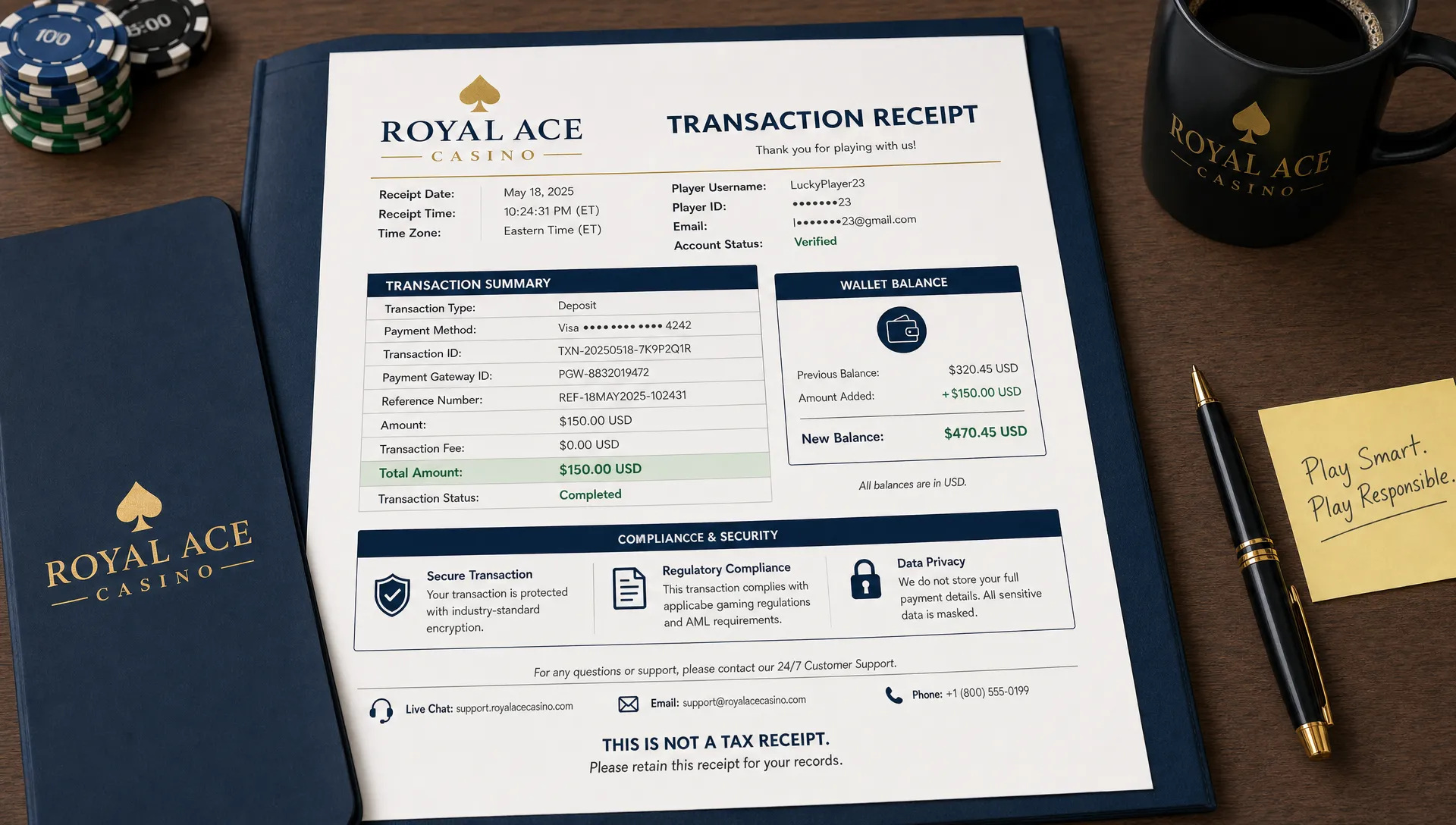
Make the player-facing receipt clear enough to prevent disputes
Many disputes start as confusion, not fraud. A player sees an unfamiliar descriptor on a bank statement, forgets a crypto onramp purchase, misunderstands a pending withdrawal or cannot find the receipt email. Better receipt UX can stop those issues before they become bank disputes.
A player-facing receipt should be short, specific and easy to retrieve. The key details are the receipt number, amount, currency, payment method, transaction time, casino account, current status and support path. For cards, show a recognizable merchant descriptor if your PSP or acquirer supports it. For crypto, show the network and transaction hash or onramp reference, with addresses partially masked unless the player needs the full address for verification.
Avoid language that creates false certainty. If a withdrawal has passed casino review but is still in provider processing, do not call it “paid” unless the payout has actually been sent. If a card authorization succeeded but wallet credit failed, do not call the whole transaction complete. Use plain labels and include an explanation.
The receipt should also be available in multiple places. Email delivery is useful, but players often lose emails or sign up with secondary inboxes. Add receipts to the account transaction history, cashier history and complaint intake flow. If a player contacts support, the agent should be able to send a receipt link or PDF without copying raw database values into a message.
Build an internal dispute packet, not a screenshot folder
A common operational failure is relying on screenshots. Screenshots are easy to create, but they are inconsistent, hard to search and easy to omit. They also fail when a UI changes after the transaction.
A better model is an internal dispute packet generated from structured data. This packet can include a summary page, payment authorization details, wallet fulfillment, player activity after credit, policy evidence and communications. Each section should reference system IDs so an analyst can verify the source record.
The best packets are generated from immutable or append-only records. If a transaction status changes from pending to credited to reversed, the evidence packet should show the timeline rather than overwrite history. This protects the operator during internal audits and external challenges.
Include enough context to make the transaction understandable, but avoid irrelevant noise. A bank reviewer does not need a full player profile if the dispute is about duplicate billing. A regulator may need a wider evidence set for a complaint involving account closure, self-exclusion or withdrawal refusal. Your receipt system should support different export templates for different use cases.
Protect sensitive data by design
A dispute receipt can become a privacy and security risk if it exposes too much information. Casino operators handle payment data, KYC records, account activity and sometimes crypto wallet information. Receipt design must balance evidentiary value with data minimization.
For card payments, follow PCI Security Standards Council requirements for protecting cardholder data. Player receipts should never display CVV or full card numbers. Use masked PAN formatting, such as card brand plus last four digits, and store sensitive authorization data only according to your PCI scope and PSP responsibilities.
For KYC and AML evidence, store references rather than copying documents into receipts. A receipt can say that the account had KYC level 2 approved at a specific timestamp and link internally to the restricted compliance record. Support agents should not need access to passports, proof of address documents or sanctions screening details to answer a basic deposit question.
For device, IP and geolocation data, show these fields only in internal views and exports meant for risk or compliance teams. If a player requests their own data under privacy law, handle that through a controlled data request process rather than exposing operational fraud signals in every receipt.
Good receipt security usually includes role-based permissions, audit logs for receipt access, redaction controls, retention rules and separate templates for player, support, finance, risk and legal users.
Add crypto-specific receipt fields
Crypto-ready casinos need receipt designs that handle blockchain and onramp realities. A crypto deposit or crypto onramp purchase is not identical to a card payment. Network, confirmation count, wallet address, exchange rate and custody model can all matter when a player disputes the outcome.
For direct crypto deposits, preserve the transaction hash, network, receiving address, detected amount, credited amount, confirmation threshold, credit timestamp and any conversion rate used. If the casino credits only after a certain number of confirmations, show that rule in the pending receipt state. If a player sends funds on the wrong network or below a minimum deposit threshold, the receipt should clearly identify the detected issue.
For crypto onramp transactions, the receipt should connect the fiat payment, onramp provider reference, crypto delivery, exchange rate, fees and casino wallet credit. Players often experience this as one flow even though multiple parties are involved. A dispute analyst needs to know which part succeeded or failed.
For withdrawals, show whether the withdrawal was requested, approved, broadcast, confirmed or rejected. If the transaction was broadcast, include the hash and network. If it was rejected, include a clear reason category such as failed KYC review, invalid address, blocked jurisdiction, insufficient balance or manual risk review.
Version the policies shown at checkout
Bonus and withdrawal disputes often depend on what the player saw at the time of the transaction. If your terms page changes after the receipt was issued, a generic link to the current terms will not prove much.
Store policy version IDs with the receipt. This applies to bonus rules, wagering requirements, withdrawal limits, refund rules, fee disclosures, restricted countries and responsible gaming notices. For bonuses, capture the campaign ID, acceptance event, wagering requirement, expiry date and any game contribution rule that affects completion.
The receipt does not need to print every word of the policy, but it should reference a preserved version that your team can produce during a complaint or regulatory review. When possible, include a short player-facing summary and a link to the full terms version active at the time.
Test receipts like a dispute analyst
Receipt QA should not stop at visual layout. Test whether the receipt can answer dispute questions under real conditions.
Use sample scenarios such as a successful card deposit, failed 3DS payment, duplicate retry, delayed wallet credit, partial refund, bonus acceptance, withdrawal rejection, crypto deposit with late confirmations and account closure before a payment attempt. For each scenario, ask whether support, finance and risk can understand the timeline without opening unrelated tools.
A practical test is to give an analyst only the receipt packet and a claim. If the analyst can draft a clear response with supporting IDs in a few minutes, the design is working. If they need to ask engineering to pull logs, the receipt is missing critical evidence or the data is too hard to interpret.
Implementation checklist for dispute-ready receipts
Use this checklist when building or auditing your receipt system.
- Create one stable receipt ID and map it to PSP, ledger, wallet, KYC and support references.
- Record UTC timestamps internally and show player-local time where useful.
- Separate player-facing fields from internal evidence fields.
- Preserve wallet balance before and after deposits, withdrawals, refunds and reversals.
- Store payment status changes as a timeline instead of overwriting the latest state only.
- Mask card numbers, wallet addresses and personal data unless full values are strictly needed in a restricted internal view.
- Attach policy version IDs for bonuses, withdrawals, refunds and fees.
- Generate dispute export packets from structured data, not manual screenshots.
- Audit who viewed, exported or modified receipt-related records.
- Test receipt packets against real dispute scenarios before launch.
This checklist is also useful when evaluating an iGaming platform, payment gateway integration or whitelabel casino software provider. Receipt quality depends on the underlying platform architecture, not just the final PDF layout.
Frequently Asked Questions
What is the difference between a casino receipt and a casino ledger entry? A ledger entry is the accounting record that changes or records balances. A receipt is a readable confirmation and evidence document derived from payment, wallet, ledger and policy data. The ledger should remain the financial source of truth.
Should casino receipts include full card or wallet details? No. Player-facing receipts should use masked values, such as card brand and last four digits or shortened wallet addresses. Full sensitive payment data should not appear in standard receipts, and card data handling must follow PCI requirements.
How long should casinos keep transaction receipts? Retention depends on licensing rules, payment provider requirements, tax rules, AML obligations and privacy laws in the markets you serve. Design your receipt system with configurable retention policies rather than a hardcoded retention period.
Do crypto casino receipts need blockchain transaction hashes? Yes, if the transaction was sent on-chain. A transaction hash, network, confirmation count and credited amount help resolve claims about missing deposits, delayed withdrawals and incorrect networks.
Can better receipts reduce chargebacks? Better receipts can reduce confusion-driven chargebacks and improve the quality of representment evidence. They will not eliminate fraud or first-party misuse, but they make legitimate transactions easier to defend.
Build receipt evidence into your casino platform from day one
Dispute-ready receipts are not an afterthought. They depend on clean payment references, ledger integrity, status timelines, policy versioning, secure data handling and a support workflow that can retrieve evidence fast.
Spinlab Studio helps operators build and launch online casino products with a modular iGaming platform that supports crypto and fiat payments, game aggregation, compliance workflows, analytics and customizable backoffice tools. If you are designing a white label casino platform or upgrading your payments stack, make receipt evidence part of the product architecture before disputes start arriving.