

A player who sees money leave a card, wallet or exchange account does not want a vague label. They want to know whether the casino received the request, whether the funds will be credited, whether they need to take action and when support should get involved.
That is the job of a casino payment status page. It is not just a receipt and it is not only a support convenience. For an online casino, it is a trust layer between the cashier, payment gateway, wallet ledger, fraud controls and player-facing experience.
When status pages are designed well, players retry less often, submit fewer “where is my money?” tickets and understand why a deposit or withdrawal is not instant. When they are designed poorly, even a normal PSP delay can look like a lost payment.
Why casino payment status pages matter
Casino payments are emotionally loaded. A pending ecommerce order is annoying. A pending casino deposit can interrupt a live game session, a promotion claim or a player’s first impression of the brand. A pending withdrawal can create even more anxiety because the player sees it as money they already won.
The worst response is a single generic status such as “processing” with no explanation. That label may be technically accurate, but it does not answer the player’s actual questions:
- Was my payment request received?
- Has the payment provider approved it?
- Has my casino balance been updated?
- Do I need to verify my account?
- When should I contact support?
A useful status page separates these questions. It gives players plain-language updates without exposing sensitive fraud, AML or payment routing logic.
For operators, the benefit is operational as much as experiential. A good status page reduces duplicate deposit attempts, improves support triage and creates fewer manual investigations caused by missing context. It also forces the platform team to define payment states clearly, which helps reconciliation and reporting.
Start with one source of truth behind the page
A payment status page should not be a decorative front end pasted on top of disconnected systems. It should reflect a real transaction state machine powered by trusted events from the casino ledger, PSP, payment gateway, bank rails, crypto infrastructure and compliance systems.
If the PSP says a payment succeeded but the casino wallet was not credited, the player-facing status must not simply say “completed.” It should show that the payment was confirmed and that the balance update is still being checked. That distinction gives support a better starting point and prevents the player from feeling ignored.
This is where payment status pages connect directly to backoffice discipline. Operators that already maintain clean transaction IDs, ledger events and reconciliation workflows can expose clearer player-facing updates. If your team is still fixing mismatches manually, review the basics of casino payments reconciliation before treating the status page as only a UX project.
| System layer | What it contributes to the status page | Player-facing example |
|---|---|---|
| Casino ledger | Wallet credit, debit, reversal and settlement events | “Your balance has been updated.” |
| PSP or payment gateway | Authorization, capture, decline, refund and payout events | “Your payment provider is processing the request.” |
| Bank, card or wallet rail | Final clearing, returns and delays | “This can take longer depending on your payment method.” |
| Crypto wallet or onramp | Network confirmation, wallet receipt and transfer completion | “We are waiting for network confirmations.” |
| KYC, AML and fraud tools | Review requirements and account restrictions | “We need to complete a verification check before payout.” |
| Support tools | Case ownership, escalation and player communication | “Our team is reviewing this transaction.” |
The player does not need to see all of those systems. The page simply needs to translate them into accurate, helpful status messages.
Use statuses players can understand
Internal payment states often use PSP codes, gateway callbacks or ledger terms that make sense to engineers and finance teams. Players need a smaller set of statuses that map to those internal events without leaking unnecessary details.
The key is to avoid false certainty. “Approved” may mean the PSP approved the transaction, not that the casino wallet is credited. “Sent” may mean the payout left the casino, not that the player’s bank has posted it.
| Player-facing status | Operational meaning | What the page should explain |
|---|---|---|
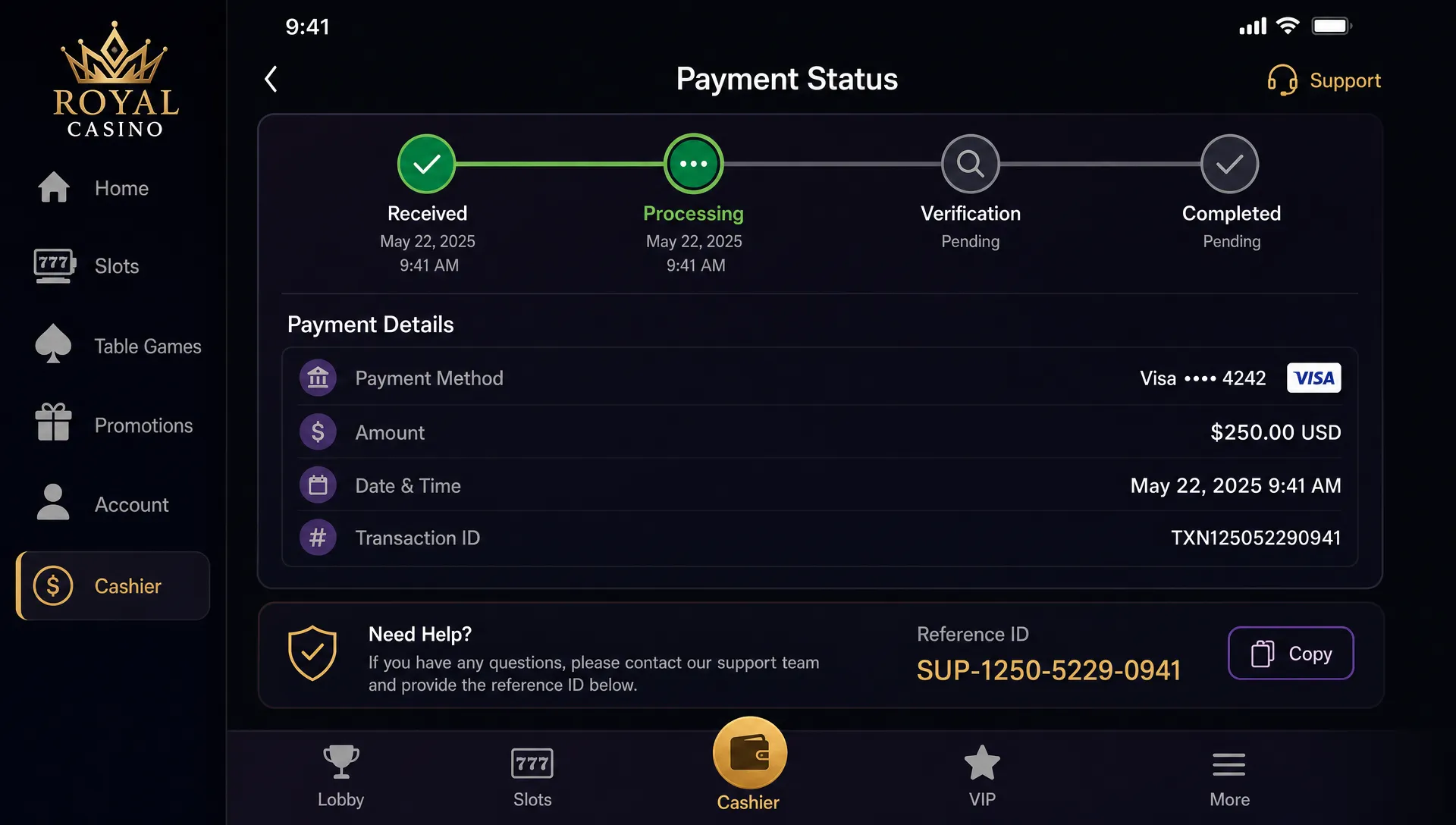
| Received | The casino has created the transaction request | The request is logged and no new attempt is needed yet. |
| Processing | The request is waiting for provider, rail or network response | The payment is not lost and the player should wait. |
| Action needed | The player must complete 3DS, KYC, bank approval or another step | The exact safe action required and where to complete it. |
| Under review | Risk, AML, limits or account checks are in progress | The transaction is being checked, without exposing risk rules. |
| Completed | The deposit is credited or the withdrawal has been paid out according to your final state | The transaction is finished from the casino’s side. |
| Failed | The provider, rail or system rejected the transaction | The player can try another method if allowed. |
| Reversed or refunded | Funds are being returned or an authorization was released | The page should clarify that posting time depends on the payment method. |
This taxonomy also improves support training. Agents can use the same language the player sees instead of translating internal codes on the fly.
When a transaction fails, do not paste raw decline messages into the page. Many decline reasons are unclear, sensitive or misleading. A card issuer code may say “do not honor,” but the player only needs to know the payment was not approved and what they can safely do next. For a deeper operational breakdown, Spinlab’s guide to payment failures in iGaming covers how to classify failures by stage and reason without turning every case into a support mystery.
Design deposit status pages for first-deposit confidence
The first deposit is one of the most fragile moments in the player journey. A player may be new to the brand, unfamiliar with the payment method and unsure whether the casino is legitimate. A clear status page can make the difference between waiting calmly and abandoning the cashier.
For deposits, the page should show the core transaction details in a compact format: amount, currency, payment method, transaction ID, creation time, last update time and current status. If the deposit is complete, it should state whether the casino balance has been credited. If it is not complete, it should explain the next step.
Common deposit scenarios need specific handling. If 3DS authentication is still open, the page should tell the player to complete bank verification rather than start a new deposit. If a bank transfer has been received but not matched, the page should confirm that the transaction is being checked. If a card authorization failed, the page should say the player was not credited and can try another available method.
Avoid combining too many outcomes into one “pending” state. A pending bank transfer, pending card authentication and pending crypto confirmation are not the same player experience. Each one needs different copy, timing guidance and support rules.
Withdrawal status pages need more care than deposit pages
Withdrawal confusion can be more damaging than deposit confusion because players already believe the money belongs to them. If the page only says “pending,” players often assume the operator is delaying payment intentionally.
A strong withdrawal page breaks the process into visible stages: request received, verification checks, review if needed, approved, sent and paid. Depending on your rails, “sent” and “paid” may not be identical. A payout can leave the casino or PSP before the player’s bank, wallet or crypto address reflects it.
The page should also distinguish between normal review and action required. If the player needs to complete KYC, upload a document or confirm wallet ownership, make that the central message. If no action is needed, say so clearly.
Do not reveal fraud thresholds, AML triggers or provider-specific risk rules. Good copy can be transparent without being exploitable: “We are completing required security checks” is safer than “Your withdrawal was flagged because your device changed.” Operators can pair this with internal rules for which withdrawals are auto-paid and which require review, a topic covered in more detail in Spinlab’s guide to casino withdrawal holds.
Crypto payment status pages require extra clarity
Crypto-ready casino platforms need status pages that explain blockchain-specific waiting states without overwhelming players. A crypto deposit can feel confusing because the player may see a transaction in an external wallet before the casino can safely credit it.
For crypto deposits, show the network, asset, amount expected, deposit address, transaction hash if available and confirmation status. If your policy requires a certain number of confirmations, show progress in plain language. For example: “We detected your transaction and are waiting for network confirmations.”
For crypto withdrawals, separate internal approval from broadcast and confirmation. A withdrawal may be approved by the casino but not yet broadcast to the network. It may also be broadcast but not fully confirmed. Those are different states and players should not have to guess which one applies.
Crypto onramps add another layer. If a player buys crypto through an onramp and uses it to fund the casino wallet, the status page should separate payment purchase approval from crypto receipt by the casino. Otherwise, a player may see a fiat card charge and assume the casino deposit should already be available.
Also handle preventable mistakes before the transaction starts. Wrong-network warnings, memo or tag requirements and minimum deposit rules should appear in the cashier before payment, but the status page should repeat the relevant detail when a transaction is being reviewed.
Write status copy for anxious players, not internal teams
Good payment status copy is short, specific and calm. It should not blame the player, overpromise timing or introduce legal language where simple guidance is enough.
| Weak copy | Better copy |
|---|---|
| “Pending” | “We received your deposit request and are waiting for your payment provider to confirm it.” |
| “Rejected by processor” | “This payment was not approved. You can try another available payment method.” |
| “Manual review” | “We are completing required checks. No action is needed from you right now.” |
| “Payout sent” | “Your withdrawal has been sent from our side. Your provider may need more time to post it.” |
| “KYC failed” | “We need one more verification step before this withdrawal can continue.” |
Copy should also be localized by market. Players in different regions have different expectations for bank transfers, card authentication, e-wallets and crypto. Time zones matter too. “Updated at 14:03” is clearer when it uses the player’s local time or states the time zone.
The safest pattern is to give each status three elements: what happened, what happens next and whether the player must do anything. If you cannot answer all three, the state definition probably needs more work.
Build support handoff into the page
A status page should reduce support tickets, but it should also improve the tickets that still arrive. When a player contacts support from the status page, the transaction ID, payment method, current status and latest event should already be attached to the case.
Do not make players retell the story from zero. If the page asks for screenshots every time, the underlying systems are probably not sharing enough data with support. Screenshots may be useful in some payment disputes, but they should not replace internal visibility.
Escalation rules should be visible to the operation team, not necessarily to the player. For example, support can see that a card deposit has had no PSP callback for a defined period, or that a withdrawal has stayed in review longer than the internal SLA. The player-facing page can keep the message simple: “This is taking longer than expected. Our team has been notified.”
Protect compliance, privacy and fraud controls
Casino payment status pages sit close to sensitive systems, so they need careful access control and data minimization. A player should only see their own transactions after secure authentication. If you send status links by email or SMS, avoid exposing full details in the link preview.
Never show full card numbers, full bank details, internal risk scores, AML rule names or provider credentials. If card details are displayed, use safe masked formats such as brand and last four digits where appropriate. Teams handling card data should align with the PCI Security Standards Council requirements that apply to their environment.
Compliance copy should be accurate but not accusatory. “We need to verify your account before completing this withdrawal” is better than language that implies wrongdoing. Players should understand the process without receiving a map of your risk controls.
Measure whether the status page is working
The best status pages are improved through real operating data. Track how players behave before and after status page changes, then review the findings with payments, support, compliance and product teams.
| Metric | What it reveals | Desired direction |
|---|---|---|
| Duplicate deposit attempts | Players are unsure whether the first attempt worked | Down |
| Payment-related support tickets | Status copy is not answering common questions | Down |
| First deposit completion rate | New players trust and finish the cashier journey | Up |
| Withdrawal inquiry rate | Players understand review and payout stages | Down |
| Status page repeat visits after SLA | A payment state may be stuck or unclear | Down |
| Support cases with transaction ID attached | Handoff from page to support is structured | Up |
Do not only measure conversion. A status page can improve trust even when a payment fails, because the player understands the outcome and knows what to do next. That trust matters for retention, especially in markets where payment methods are inconsistent or banking rails are slow.
What to ask your casino software provider
Payment status pages are much easier to build when the platform has payment, wallet, compliance and backoffice systems that communicate cleanly. Before launching or migrating an online casino, operators should ask practical questions:
- Can the platform show separate states for PSP approval, wallet credit and settlement?
- Can status copy be customized by payment method, currency and market?
- Can support agents see the same timeline as the player, plus internal context?
- Can crypto deposits and withdrawals show network-specific states?
- Can fraud, KYC and AML reviews be reflected without exposing sensitive rules?
- Can analytics show where players get stuck or create support tickets?
Spinlab’s modular iGaming platform is built for operators that need flexible payment flows across fiat and crypto, with integrated compliance tooling, fraud prevention, game aggregation, analytics and a customizable backoffice. For operators comparing platform options, status visibility should sit next to approval rates, reconciliation and routing as a core payment requirement.
Frequently Asked Questions
What is a casino payment status page? A casino payment status page is a player-facing page that shows the current state of a deposit or withdrawal. It usually displays the amount, currency, payment method, transaction ID, current status, latest update and next step.
Why do casino payment status pages reduce support tickets? They answer the questions players usually ask support: whether the payment was received, whether it is still processing, whether action is needed and when the transaction is complete. Clearer status messages reduce duplicate tickets and unnecessary retries.
Should casinos show exact payment decline reasons? Not always. Some decline reasons are too vague, sensitive or risky to expose. It is usually better to give a safe explanation, such as “This payment was not approved,” then guide the player to try another available method if allowed.
What should a crypto casino payment status page show? It should show the asset, network, amount, transaction hash when available, confirmation status and whether the casino wallet has credited the funds. For withdrawals, it should separate internal approval, broadcast and network confirmation.
How many payment statuses should an online casino use? Most casinos can start with a small player-facing set: received, processing, action needed, under review, completed, failed and refunded or reversed. Internal systems can keep more detailed states behind those labels.
Build payment clarity into your casino platform
Payment confusion is rarely caused by one missing label. It usually comes from disconnected systems, unclear wallet states and status messages written for internal teams instead of players.
If you want a white label casino platform with flexible fiat and crypto payment support, compliance tools, fraud prevention, analytics and a customizable backoffice, Spinlab gives operators a practical foundation for building clearer payment experiences from launch.