

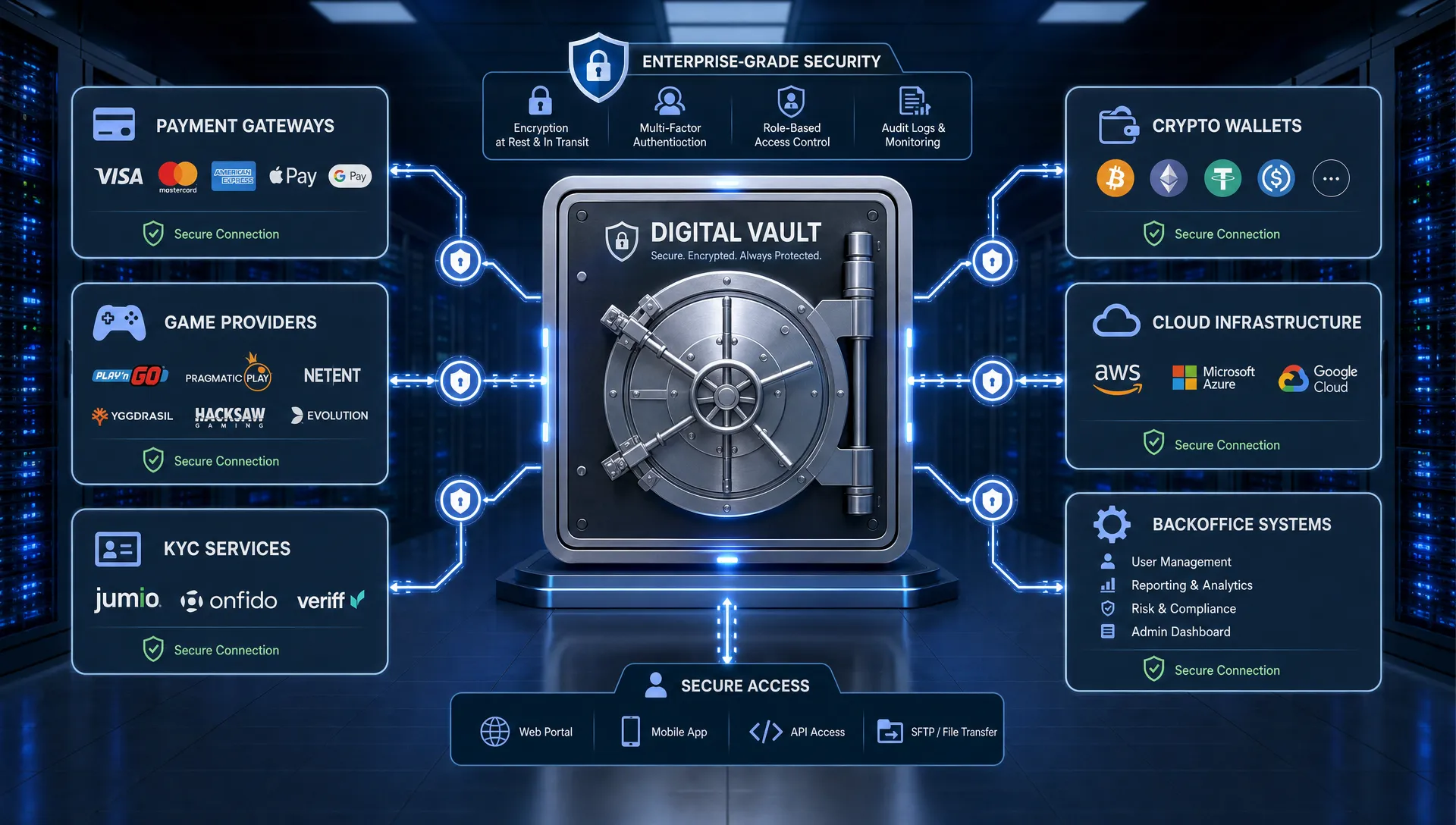
An iGaming platform runs on secrets. Payment gateway keys, game provider credentials, webhook signing tokens, database passwords, KYC vendor API keys, affiliate postback secrets, cloud access keys, and crypto wallet permissions all decide who can move money, validate bets, approve identities, and access player data.
That makes secrets management more than a developer hygiene task. For an online casino, it is a control layer for revenue, compliance, fraud prevention, and uptime. A leaked secret can turn into manipulated callbacks, unauthorized payment actions, fake vendor traffic, data exposure, or a rushed shutdown while teams rotate keys under pressure.
The goal is simple: make secrets hard to steal, hard to misuse, easy to rotate, and easy to audit without slowing down product work.
What counts as a secret in an iGaming platform?
A secret is any credential, key, token, certificate, or private value that grants access to a system or proves trust between systems. In iGaming, secrets appear across more vendor relationships than in many other digital products because a casino platform usually connects payments, game aggregation, identity checks, affiliate tracking, analytics, customer support, fraud tooling, and compliance systems.
The most dangerous mistake is treating secrets as ordinary configuration. A country code, bonus percentage, or game category can live in normal configuration. A payout API key, JWT signing key, or webhook secret cannot.
| Secret type | Common iGaming example | Why it matters |
|---|---|---|
| Payment credentials | Payment gateway API keys, payout tokens, merchant IDs | Can affect deposits, withdrawals, refunds, and settlement workflows |
| Game provider credentials | Aggregator API keys, callback secrets, launch tokens | Can affect game sessions, round validation, balances, and provider reporting |
| Crypto access secrets | Custodial wallet credentials, onramp API keys, signing permissions | Can expose funds, addresses, transaction approvals, or treasury operations |
| Compliance vendor secrets | KYC, AML, sanctions, and age verification API tokens | Can expose sensitive identity workflows and regulatory evidence trails |
| Platform secrets | Database passwords, service tokens, encryption keys, JWT keys | Can expose player data, sessions, internal services, and admin functions |
| Affiliate and marketing secrets | Postback tokens, tracking API keys, CRM credentials | Can create fake conversions, campaign leakage, or bonus abuse |
| Infrastructure secrets | Cloud IAM keys, deployment tokens, container registry credentials | Can allow attackers to change production systems or extract data |
If a value can authorize an action, decrypt data, impersonate a service, or validate a request, it belongs in your secrets management program.
Why secrets management is harder for online casinos
A standard SaaS company may have a few payment and cloud secrets. An online gambling platform often has dozens of high-trust integrations operating in real time. Player deposits, wagers, bonuses, jackpot contributions, game rounds, withdrawals, identity checks, and affiliate events all cross system boundaries.
This creates four pressures that make iGaming secrets management unique.
First, the blast radius is financial. If a low-permission analytics token leaks, the impact may be limited. If a payment key, wallet access token, or game callback secret leaks, the attacker may affect balances, payouts, or transaction reconciliation.
Second, vendors are operationally critical. A casino may depend on separate providers for slots, live casino games, payment gateway access, crypto onramp flows, KYC, AML screening, CRM, bonus tooling, and risk scoring. Each vendor adds credentials, webhook signatures, environment-specific keys, and rotation procedures.
Third, iGaming teams often move fast. New brands, markets, bonus campaigns, game providers, and payment routes may be launched quickly. Speed is valuable, but rushed launches often lead to secrets in shared spreadsheets, chat messages, repository variables with excessive access, or copied production keys in staging.
Fourth, regulation increases the need for evidence. Operators must be able to show who had access, when a credential changed, and how sensitive data and payment workflows are protected. For a wider launch security view, Spinlab’s guide to casino platform security basics for new operators is a useful companion to this more technical secrets-focused checklist.
The core principles of secrets management for iGaming platforms
Good secrets management is not just buying a vault. It is a lifecycle that covers creation, storage, access, runtime use, rotation, monitoring, and deletion.
The OWASP Secrets Management Cheat Sheet recommends avoiding secrets in source code, protecting secrets in transit and at rest, restricting access, auditing use, and rotating credentials. Those principles are especially important in casino software because many secrets connect directly to money movement or regulated player data.
Keep secrets out of code, logs, and frontends
No payment key, game aggregator token, JWT signing secret, database password, or crypto-related credential should be hardcoded in an application repository. This applies to private repositories too. Private repositories are not vaults, and they are often accessible to more developers, contractors, CI tools, and integrations than operators realize.
Secrets also must not appear in mobile apps, browser JavaScript, analytics events, support screenshots, crash reports, or application logs. A player-facing frontend should never contain a secret that can authenticate directly to a provider. If a browser can read it, an attacker can read it.
Use a centralized vault or managed secrets service
A secrets manager provides encrypted storage, access policies, audit logs, and controlled retrieval. Depending on your stack, that may be a cloud secrets manager, a dedicated vault, a KMS-backed system, or a platform-managed approach.
The important point is centralization. If secrets are spread across .env files, CI variables, shared documents, developer laptops, and vendor portals, no one has a reliable inventory. Without inventory, rotation becomes guesswork.
Apply least privilege to every secret
A secret should grant only the permissions needed for one service, one environment, and one purpose. The key used to verify a payment webhook should not be able to initiate payouts. A staging game provider key should not work in production. A reporting API token should not be able to change balances.
This is where permission design matters. Short-lived credentials, scoped API tokens, separate read and write keys, IP allowlists, mTLS, and HMAC-signed requests can all reduce impact when something goes wrong.
Separate brands, environments, and tenants
Many operators eventually run multiple casino brands, market-specific domains, or regional payment setups. Shared secrets across brands create shared incidents. If Brand A’s staging system leaks a production payment credential used by Brand B, the problem spreads instantly.
At minimum, separate secrets by production, staging, development, brand, market, and vendor integration. Multi-brand operators should be especially strict about naming, ownership, and access boundaries.
Rotate before you are forced to rotate
Rotation is easy to promise and hard to execute under pressure. The right time to test rotation is before a leak, not during one. Payment gateway credentials, KYC vendor tokens, webhook signing secrets, game provider API keys, JWT signing keys, and cloud credentials should all have documented rotation procedures.
Not every secret needs the same frequency. The highest-risk credentials, especially those tied to payouts, wallet access, privileged admin functions, or production databases, deserve tighter rotation windows and stronger approval controls.
A practical secrets lifecycle for casino operators
Secrets management becomes much easier when each credential has a clear lifecycle. A simple lifecycle also helps lean teams avoid overengineering while still maintaining control.
| Lifecycle stage | What to do | iGaming example |
|---|---|---|
| Discover | Find existing secrets and remove unsafe copies | Scan repositories for payment keys, game provider tokens, and database passwords |
| Classify | Rank by risk and business impact | Mark payout keys, wallet credentials, and production database secrets as critical |
| Assign ownership | Name the team or role responsible | Payments owns gateway secrets, platform owns service tokens, compliance owns KYC keys |
| Store | Move secrets into a controlled manager | Replace shared .env files with vault-backed runtime injection |
| Grant access | Use least privilege and approvals | Let a deployment service read a secret without letting every developer view it |
| Use safely | Inject at runtime and avoid logging | Load the game provider token server-side and redact it from traces and logs |
| Rotate | Replace without downtime when possible | Run old and new webhook secrets during a short transition window |
| Revoke | Remove unused or compromised credentials | Delete keys for retired game providers, old payment routes, and inactive contractors |
| Audit | Review access and anomalies | Check who accessed a production wallet-related credential before a withdrawal incident |
This lifecycle should be written down. If key rotation depends on one engineer remembering a vendor portal workflow, the operator is carrying key-person risk.
iGaming-specific controls to prioritize
Generic secrets advice is helpful, but casino operators should pay special attention to the workflows where secrets protect balances, wagers, and regulated data.
Payment gateway and payout credentials
Payment credentials should be split by capability. Deposit processing, refund actions, payout initiation, reconciliation, and reporting should not all use the same all-powerful key if the provider supports scoped credentials.
Webhook validation is equally important. Payment callbacks should be signed and verified server-side before a deposit or withdrawal status changes. Store webhook secrets in a vault, log signature verification failures without exposing the secret, and alert on sudden spikes in invalid callbacks.
If you handle cardholder data directly, PCI DSS requirements become relevant. Many operators reduce scope by using hosted payment fields or gateway-managed flows, but payment secrets still deserve strong internal controls. The PCI Security Standards Council maintains official PCI DSS resources for teams that need to understand their obligations.
Game aggregator and provider credentials
Game aggregation creates a dense trust network. The platform may receive game launch requests, session tokens, round callbacks, balance updates, bonus interactions, and rollback messages. A weak secret model can let attackers replay or forge requests if endpoint validation is poor.
Use separate credentials per provider, brand, and environment. Verify callback signatures, timestamps, nonce values, and idempotency keys where supported. Balance-changing events should be traceable to a specific provider, credential, game round, and player session.
Crypto onramp and wallet-related secrets
Crypto-ready platforms need extra discipline. Onramp provider keys, wallet service credentials, withdrawal approval tokens, and signing permissions should be treated as critical. Do not place wallet seed phrases, private keys, or recovery material in application configuration, CI systems, chat tools, or documentation.
If your model involves custodial wallets, define who can approve changes, how access is logged, and how emergency revocation works. If your model involves signing transactions, consider hardware-backed key storage, MPC, HSMs, or a reputable custody provider depending on your risk profile and regulatory context.
KYC, AML, and player identity services
Identity verification secrets protect access to sensitive personal data. A leaked KYC API token may expose identity documents, verification outcomes, or compliance records depending on the vendor’s permissions.
Access should be restricted by role and service. Developers usually do not need direct access to production KYC tokens. Support agents may need to view verification status, but not vendor credentials. Compliance staff may need audit exports, but not application secrets.
Backoffice and admin systems
Casino backoffice software is powerful because it can adjust players, bonuses, limits, payments, and risk decisions. Secrets that grant backoffice access or sign admin sessions need strong protection.
Use MFA, role-based access control, short session lifetimes for privileged roles, and separate admin credentials from service credentials. If a backoffice action requires a high-risk API token behind the scenes, that token should be invisible to the human user and protected by server-side authorization.
Secrets in CI/CD and deployment pipelines
CI/CD systems are common leak points because they connect source code, tests, deployment environments, cloud accounts, and container registries. For iGaming teams shipping new games, payment routes, and bonus mechanics quickly, pipeline access can become overly broad.
A safer pattern is to let the deployment process request secrets at runtime through a controlled identity, rather than storing long-lived production keys directly in pipeline variables. Build jobs should not have access to production secrets unless they truly deploy to production. Test jobs should use test credentials, mock providers, or sandbox integrations.
Pay attention to logs. A failed deployment should not print environment variables, full HTTP headers, provider tokens, or signed URLs. Redaction rules should be tested because many leaks happen during debugging, not during normal operation.
Monitoring, alerts, and incident response
Secrets management is incomplete without detection. Even well-designed controls can fail through phishing, misconfiguration, vendor compromise, accidental commits, or overly permissive access.
Monitor for unusual access patterns, such as a credential being read outside deployment windows, a service retrieving secrets it never used before, a spike in webhook signature failures, or payment actions from unexpected IP ranges. Repository scanning and CI scanning should block obvious leaks before code is merged.
The most important incident response rule is not to panic-rotate blindly. Start by identifying which secret was exposed, what it could access, where it was used, and whether the attacker may have used it. Then revoke or rotate, review logs, notify affected vendors if needed, and verify downstream data integrity.
A practical incident plan should include owners for payment credentials, game provider secrets, crypto-related access, KYC vendor tokens, cloud credentials, and backoffice admin access. For the monitoring side, Spinlab’s guide to observability for iGaming explains how metrics, traces, logs, and alerts can support faster incident handling.
Vendor due diligence questions to ask
Whether you build in-house, use a turnkey casino solution, or choose a white label casino platform, secrets management should be part of vendor evaluation. Operators do not need every implementation detail, but they should ask enough to understand maturity and risk.
| Question | Why it matters |
|---|---|
| How are production secrets stored and encrypted? | Confirms secrets are not scattered across files, scripts, or shared documents |
| Can secrets be scoped by brand, environment, and role? | Reduces blast radius for multi-brand or multi-market operators |
| Is access to secrets audited? | Supports investigations and compliance evidence |
| How are payment and payout credentials separated? | Prevents one leaked key from enabling multiple financial actions |
| How are webhook secrets rotated without downtime? | Protects payment and game callbacks while maintaining uptime |
| Are logs and traces automatically redacted? | Prevents credentials from leaking through observability systems |
| What is the emergency revocation process? | Determines whether the team can respond quickly during a live incident |
| How are crypto-related credentials protected? | Reduces risk around onramps, custodial wallets, and transaction permissions |
A good casino software provider should be able to answer these questions clearly. Vague answers such as it is secure or only admins can access it are not enough for systems that handle real-money gaming.
Metrics that show secrets management is working
Operators should turn secrets management into measurable operations. The objective is not to create paperwork, but to know whether risk is shrinking over time.
Useful metrics include rotation coverage, number of secrets older than policy, percentage of secrets with named owners, time to revoke a critical credential, number of secrets found in code scans, number of production secrets accessible by humans, and number of unused credentials still active.
Track these metrics alongside security incidents and operational changes. If your team adds three new payment routes and two game providers in a month, your secret inventory should show the same growth. If a brand is retired, the related provider keys, webhook secrets, affiliate tokens, and reporting credentials should be revoked as part of shutdown.
Frequently Asked Questions
What is secrets management for iGaming platforms? Secrets management is the process of securely storing, controlling, rotating, auditing, and revoking the credentials that power an iGaming platform. These include payment keys, game provider tokens, KYC API keys, database passwords, webhook signing secrets, cloud credentials, and crypto-related access credentials.
Are environment variables safe for casino platform secrets? Environment variables can be part of a safe runtime pattern, but they are not a complete secrets management strategy by themselves. Secrets still need encrypted storage, access control, audit logs, rotation procedures, and protection from logs, crash reports, and overly broad developer access.
How often should online casino operators rotate secrets? Rotation frequency depends on risk. High-impact secrets tied to payouts, wallet access, production databases, privileged admin actions, and signing keys should be rotated more aggressively than low-risk reporting tokens. The bigger priority is having a tested rotation process before an emergency happens.
Should operators store crypto private keys in their application? No. Crypto private keys, seed phrases, and recovery material should not be stored in application code, CI variables, chat, tickets, or standard configuration files. Operators should use appropriate custody, hardware-backed signing, MPC, HSM, or specialized wallet infrastructure based on their model and regulatory obligations.
What is the biggest secrets management mistake in iGaming? The biggest mistake is sharing powerful production credentials across too many systems, brands, or people. A single all-purpose key for payments, game callbacks, or admin operations creates unnecessary blast radius and makes incident response much harder.
Build your casino platform on safer operational foundations
Secrets management is one of the hidden differences between a casino platform that is easy to launch and one that becomes risky to operate. The right approach protects payment workflows, game integrations, player data, crypto access, and backoffice operations without forcing your team to manage everything manually.
Spinlab offers a modular, all-in-one iGaming platform for operators building, launching, and scaling online casinos, with crypto and fiat payments, compliance capabilities, game aggregation, analytics, fraud prevention, and a customizable backoffice. If you want a Shopify-like path to launching a white label casino while keeping operations lean, start by choosing infrastructure that treats secrets, access, and integrations as core platform concerns from day one.