

A casino help center should not be a quiet corner of your website where old policy pages go to die. For an online casino, it is one of the most practical tools for lowering support volume, speeding up agent work and preventing confusion around money, verification, bonuses and gameplay.
The best help centers reduce tickets because they answer the exact question a player has at the exact moment they are about to ask it. That means your help center cannot be built from guesses or generic FAQ templates. It needs ticket data, clear ownership, product placement and ongoing maintenance.
For iGaming operators, this matters more than in most industries. A vague withdrawal article can create hundreds of live chat messages. A confusing bonus explanation can become a dispute queue. A missing KYC page can make legitimate players feel blocked, even when the review is required.
Below is a practical framework for creating a casino help center that reduces tickets without hiding support, frustrating players or weakening compliance.
Treat the help center as part of casino operations
Ticket reduction is not the same as making support harder to reach. In gambling, players must still be able to access help quickly for account security, responsible gambling, payment problems and complaints. The goal is to remove avoidable tickets, not necessary conversations.
A strong casino help center supports three groups at once:
- Players who want a quick answer before contacting support
- Agents who need a single source of truth while answering tickets
- Ops, payments, risk and compliance teams that need consistent public messaging
This is why the help center should sit inside your operating model, not just your content calendar. If payments change a withdrawal rule, the article must change. If compliance updates verification requirements, support scripts and help center pages must stay aligned. If a bonus campaign launches, its public explanation should be written before the campaign goes live.
The Consortium for Service Innovation's Knowledge-Centered Service model is useful here because it treats knowledge as something created and improved through real support work. In a casino context, that means every repeated ticket is a signal that an article is missing, unclear or placed too far away from the user journey.
Start with ticket demand, not article ideas
Most help centers fail because they begin with a list of topics the business wants to explain. Effective ticket reduction starts with the questions players are already asking.
Pull the last 60 to 90 days of tickets from live chat, email and social support. Tag each ticket by journey stage, reason and outcome. If your tagging is messy, manually review a sample of the highest-volume categories. You are looking for patterns, not perfect taxonomy.
Useful tags include stage, such as registration, deposit, gameplay, bonus, withdrawal or account security. Add reason tags such as how-to, status request, failed action, policy confusion, document rejected, dispute or complaint. Where possible, add payment method, device type, language and market.
A simple table can reveal where your help center will have the biggest impact.
| Ticket cluster | Common player question | Help center page that can reduce tickets | Best in-product placement |
|---|---|---|---|
| Withdrawals | “Where is my payout?” | Withdrawal timelines, statuses, documents and method-specific rules | Cashier withdrawal screen and transaction history |
| KYC | “Why was my document rejected?” | Accepted documents, photo quality tips and review expectations | Verification flow and account settings |
| Deposits | “Why did my payment fail?” | Payment troubleshooting by method, including card, bank transfer and crypto | Failed deposit message in the cashier |
| Bonuses | “Why did I not receive my bonus?” | Eligibility, wagering examples, excluded games and expiry rules | Bonus detail page and promotion banners |
| Game issues | “My slot froze, what happens now?” | Game interruption steps, round history and what support needs | Game error message and recent game history |
| Account access | “I cannot log in.” | Password reset, 2FA, locked accounts and suspicious activity | Login error states |
| Responsible gambling | “How do I set limits or self-exclude?” | Clear guidance on limits, time-outs and self-exclusion | Account menu and footer |
Do not try to write 200 articles at once. Start with the top 10 to 20 ticket drivers, then improve based on search data and contact rate.
Build categories around player journeys
Your help center navigation should match how players think, not how your company is organized internally. Players do not care whether a topic belongs to payments, risk, compliance or CRM. They care about what they are trying to do.
For an online casino, a practical structure usually includes these categories:
- Getting started
- Deposits and payment methods
- Withdrawals
- Verification and account security
- Bonuses and promotions
- Games and technical issues
- Responsible gambling
- Complaints and dispute handling
Each category should answer both “how do I do this?” and “why is this happening?” For example, a withdrawal section should not only explain how to request a withdrawal. It should explain why a withdrawal may be pending, what “under review” means, why verification may be requested and what information the player should prepare if they contact support.
If you support fiat and crypto payments, separate method-specific guidance where it matters. A card decline, a bank transfer delay and a crypto confirmation delay are not the same player experience. Lumping them into one generic “payments” article often creates more tickets because the answer feels incomplete.
Write articles for anxious players, not internal policy teams
Casino support tickets often come from anxiety. A player has money pending, a document rejected, a bonus missing or a game round interrupted. Long policy pages written in legal language rarely calm that anxiety.
A ticket-reducing article should answer the main question in the first two or three sentences. Then it can explain conditions, exceptions and next steps.
Use this article structure for high-volume topics:
- Start with the direct answer
- Show the steps the player can take now
- Explain common reasons the issue happens
- State what the casino can and cannot change
- Tell the player when contacting support is useful
- List the information support needs if contact is required
For example, an article titled “Why is my withdrawal pending?” should not begin with the full withdrawal policy. It should first explain that pending means the withdrawal has been requested but not yet completed, then show the most common causes: payment method processing time, verification review, fraud checks or incomplete account details.
The article should also reduce unnecessary chats by telling players what to check before contacting support: transaction status, email requests for documents, selected payment method and any account notifications.
Turn withdrawal, KYC and bonus pages into support deflection engines
Not all help center topics carry the same ticket load. In online gambling, three areas usually deserve extra care: withdrawals, identity verification and bonuses.
Withdrawals are often the highest-emotion support category because the player is waiting for money. Your withdrawal help center should explain each status in plain language: requested, pending, under review, approved, paid, rejected or canceled. It should also separate review time from payment network time. Those are different things, but players often experience both as “the casino is delaying me.”
If withdrawal tickets are a major cost center, use a dedicated playbook like Spinlab's guide on reducing withdrawal support tickets and connect those improvements to your help center content.
KYC content should focus on preventing failed submissions. Show acceptable document types, image quality requirements, address verification rules and common rejection reasons. Avoid vague lines like “upload a valid document.” Instead, explain what valid means in practical terms: readable, not expired, full document visible and matching the account details.
Bonus content needs examples. Wagering requirements, maximum bet rules, game weighting and expiry windows can be confusing even for experienced players. A good bonus article should include a simple worked example and link from every promotion that uses those terms.
Put help where tickets are created
A help center that only lives in the footer will not reduce enough tickets. The strongest deflection happens inside the product flow, just before the player would open chat.
Place contextual help links in high-friction moments: failed deposits, withdrawal status pages, document upload screens, login errors, bonus opt-in confirmations and game interruption messages. The link text should match the player's immediate question. “Why did my deposit fail?” is better than “Payment help.”
For casino operators, this also means your backoffice and support tools need to show the same information agents are expected to communicate. If an agent can see payment status, verification state, bonus activity and previous player contacts in one place, they can answer faster and spot gaps in the help center. Spinlab's article on casino admin panel features that save time daily covers this operational side in more detail.
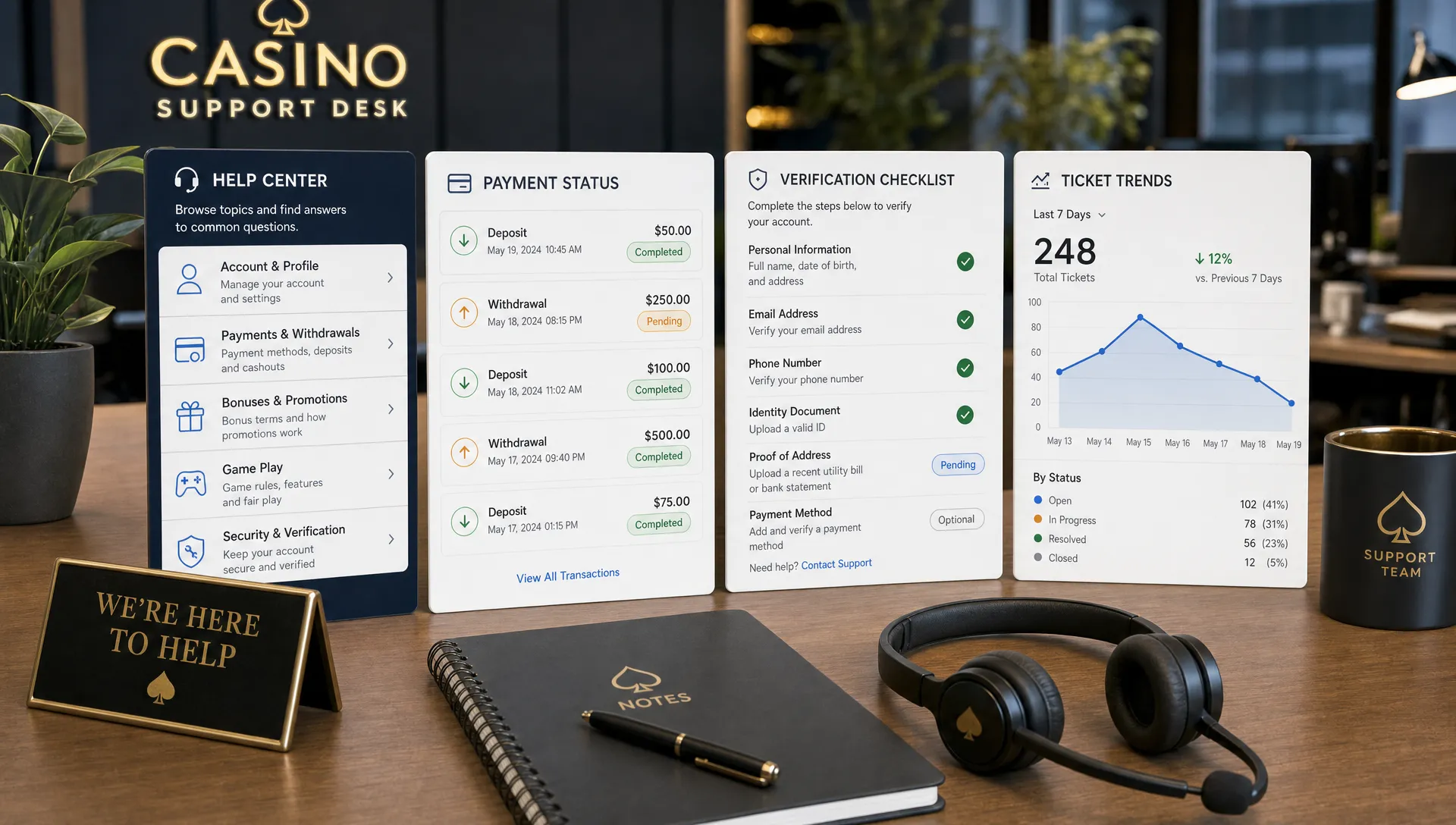
Contextual help should not replace live support for urgent or sensitive situations. If the topic is account compromise, self-exclusion, gambling harm or a formal complaint, make the contact path clear and direct.
Make search work like players actually type
Players rarely search using your internal terminology. They search with messy, emotional or local phrases: “cash out stuck,” “bonus not added,” “ID failed,” “crypto deposit missing,” “slot froze” or “can't withdraw.”
Your help center search should account for synonyms, spelling variations and market-specific language. Add alternative phrases to article titles, summaries or metadata where your help center tool allows it. Review failed searches every week during launch, then monthly once the content stabilizes.
Useful synonym groups for casino help centers include:
| Internal term | Player search terms to support |
|---|---|
| Withdrawal | Cash out, payout, money pending, withdraw money |
| Verification | KYC, ID check, documents, proof of address, account review |
| Deposit | Payment failed, card declined, crypto missing, bank transfer |
| Bonus | Free spins, promo, wagering, bonus missing, offer not working |
| Responsible gambling | Limits, self-exclusion, time-out, cool off, close account |
| Game round | Slot froze, bet stuck, game crashed, round result |
Search analytics are one of the best sources for new article ideas. A high-volume search with no result is a content gap. A high-volume search with an article but a high contact rate is a clarity or placement problem.
Keep compliance involved without making articles unreadable
A casino help center has to be clear, but it also has to be accurate. Payment rules, bonus terms, KYC requirements, account closure, responsible gambling and complaints can all have regulatory implications.
The solution is not to let legal language take over every article. Instead, separate plain-language explanation from official terms. A bonus article can start with a simple explanation and then point to the full terms for players who need the legal detail. A responsible gambling article should use direct, careful language and make support options easy to find.
Use an approval workflow for regulated topics. Assign an owner to each article, note the last review date internally and require review before major launches or market changes. If your operator runs in multiple jurisdictions, avoid copying the same help article across markets unless the rules genuinely match.
For search visibility, structured content can also help search engines understand your help pages. Google's structured data guidelines are a useful reference, especially for breadcrumb, article and organization markup. Do not add markup that misrepresents the content, and remember that rich result eligibility is controlled by Google.
Design for mobile, accessibility and global scale
Most casino help requests happen on mobile, often while the player is already in the cashier, account area or game lobby. If your help center is hard to read on a phone, it will push players back to chat.
Mobile help articles should use short sections, descriptive headings and visible next steps. Tables can help, but they must be readable on small screens. Avoid burying the answer under banners, popups or long introductions.
Accessibility also matters. Clear contrast, keyboard navigation, readable form labels and descriptive link text help more players solve problems without contacting support. The W3C Web Content Accessibility Guidelines are the standard reference for making digital content easier to use for people with different access needs.
For multi-market casinos, translation is not enough. Localize examples, payment method names, currency references and responsible gambling wording. A crypto-ready solution may need separate guidance for network selection, confirmations and wallet address accuracy, while fiat markets may need more card, bank transfer or local payment method guidance.
Connect the help center to agent workflows
A help center reduces tickets more effectively when agents use it every day. If support teams answer from private notes while players read different public articles, inconsistency is almost guaranteed.
Create an agent workflow where repeated answers become public articles or internal macros. When an agent resolves a ticket that should not have required contact, they should be able to flag the gap: missing article, unclear article, outdated article or wrong placement.
Your backoffice can support this by making player context easier to interpret. Payment history, wallet status, KYC state, bonus activity, fraud review flags and game session details all help agents answer accurately. This is also where operational cost reduction connects to self-service. The more your platform reduces manual lookup work, the easier it becomes to maintain clear support content at scale. Spinlab's guide to reducing casino ops costs without cutting features explores that broader operating model.
Measure ticket reduction with the right metrics
A help center should be measured like a product. Page views alone do not prove success. A popular article might be reducing tickets, or it might be confusing enough that everyone has to read it before contacting support.
Track metrics that connect article usage to support outcomes.
| Metric | What it tells you | How to use it |
|---|---|---|
| Tickets per 1,000 active players | Whether support load is rising or falling relative to player base | Track by category, market and product change |
| Article view to contact rate | Whether an article answers the question well enough | Rewrite pages with high views and high contact rate |
| No-result searches | What players need but cannot find | Create or rename articles based on real queries |
| Repeat contact rate | Whether players need multiple conversations for the same issue | Improve article clarity and agent macros |
| Average handle time by category | Whether content helps agents answer faster | Link macros to approved help center pages |
| Deflected withdrawal or KYC tickets | Whether high-volume operational topics are improving | Compare before and after content and UX changes |
| CSAT after self-service or support | Whether ticket reduction is hurting or helping player trust | Watch for reduced tickets with declining satisfaction |
Be careful with “deflection rate” as a vanity metric. If players cannot contact support, tickets may go down while frustration goes up. A healthy help center reduces repeatable, low-value tickets while preserving clear paths to support for complex, urgent or regulated issues.
A 30-day rollout plan
A casino help center does not need a six-month documentation project to start reducing tickets. A focused 30-day rollout can make a visible difference if you prioritize the right topics.
| Timeline | Focus | Output |
|---|---|---|
| Days 1 to 5 | Ticket audit | Top ticket categories, search terms and article priorities |
| Days 6 to 10 | Help center structure | Journey-based categories and article templates |
| Days 11 to 18 | Content creation | First 10 to 20 high-impact articles, reviewed by relevant teams |
| Days 19 to 23 | Product placement | Contextual links in cashier, KYC, bonus and account flows |
| Days 24 to 27 | Agent enablement | Macros, internal notes and escalation rules linked to articles |
| Days 28 to 30 | Measurement setup | Baseline metrics, dashboard views and review cadence |
After launch, run a weekly review for the first month. Look at top searches, no-result searches, tickets after article views and agent feedback. Update quickly. A help center that improves every week will outperform a larger one that is only reviewed once a year.
Common mistakes that keep ticket volume high
One common mistake is publishing policy pages instead of help articles. A policy may be necessary, but it rarely answers a stressed player's immediate question. Use policy as a source, then write a clear operational explanation on top of it.
Another mistake is ending every article with “contact support” too early. If the article does not tell the player what to check first, it becomes a signpost to the ticket queue rather than a deflection tool.
Outdated bonus and payment pages are also ticket generators. Promotions change often, payment methods can have different rules by market and KYC requirements can shift. Assign owners to these pages and review them before major campaigns.
Finally, many casinos create useful articles but fail to place them inside the player journey. If the answer to “why is my withdrawal pending?” only exists in the footer help center, many players will still open chat from the cashier.
Frequently Asked Questions
What help center articles reduce casino support tickets fastest? Withdrawal status, KYC document rejection, failed deposits, missing bonuses, login problems and game interruption articles usually reduce tickets fastest because they match high-volume, high-anxiety moments.
How many articles should a casino help center launch with? Start with 10 to 20 high-impact articles based on real ticket data. A small, accurate help center that covers the biggest issues is better than a large library of generic content.
Should a casino help center include responsible gambling content? Yes. Responsible gambling pages should be easy to find, clearly written and connected to the relevant account tools or support paths. Do not hide urgent help behind generic FAQ navigation.
How do you measure whether a help center is reducing tickets? Track tickets per 1,000 active players, article view to contact rate, no-result searches, repeat contacts and category-level ticket volume before and after publishing or updating articles.
Can a help center replace live chat for an online casino? No. A help center should reduce avoidable tickets, but live support remains essential for sensitive, urgent, regulated or account-specific issues.
Build support reduction into the platform, not just the FAQ
A casino help center reduces tickets when it is connected to product flows, agent workflows and real operational data. That is much easier when your iGaming platform already centralizes payments, KYC and AML workflows, fraud prevention, wallet activity, game aggregation, analytics and backoffice administration.
Spinlab offers a modular, crypto-ready online casino platform designed for fast onboarding, flexible integrations and efficient operations. If you are building or scaling a whitelabel casino, the right platform foundation can make self-service support easier to maintain from day one.