

A casino business continuity plan is the operating system for staying live when something important breaks. For an online casino, disruption is not just an IT inconvenience. It can affect player balances, deposits, withdrawals, game rounds, KYC checks, responsible gambling controls, affiliate traffic, regulator confidence, and revenue by the minute.
The goal is not to pretend failures will never happen. The goal is to define what must keep running, what can safely degrade, who makes decisions, and how the business protects players while restoring normal operations.
In 2026, this matters even more because modern casino operations are highly interconnected. A single brand may depend on a cloud region, a whitelabel casino platform, a payment gateway, a crypto onramp, fraud tooling, identity verification, a game aggregator, live casino suppliers, SMS providers, affiliate systems, and customer support tooling. A strong business continuity plan brings those dependencies into one practical operating model.
What a casino business continuity plan should cover
A business continuity plan, often shortened to BCP, defines how the business continues delivering critical services during disruption. It is broader than a technical recovery document.
The international standard ISO 22301 frames business continuity management around preparing for, responding to, and recovering from disruptive incidents. For an iGaming operator, that means your plan should cover technology, people, vendors, compliance, communications, and money movement.
A casino BCP should answer five practical questions:
- Which services are critical to player safety, financial integrity, and legal operation?
- What level of degraded operation is acceptable for each service?
- Who has authority to pause deposits, disable games, block withdrawals, notify vendors, or contact regulators?
- How will teams communicate with players, partners, affiliates, and internal stakeholders?
- How often will the plan be tested, updated, and audited?
Business continuity is closely related to disaster recovery and incident response, but it is not the same thing. A casino disaster recovery plan focuses on restoring systems, data, and workloads against specific RPO and RTO targets. An iGaming incident response playbook focuses on managing incidents from detection to containment and resolution. The BCP sits above both and keeps the commercial operation coordinated while technical teams recover services.
Start with the exact business scope
Do not begin with a generic template. Start with the real shape of your casino business.
Document every brand, market, license, payment method, currency, player segment, vendor, and operational team in scope. A single online gambling platform may serve different regions with different KYC rules, AML thresholds, game portfolios, tax reporting requirements, and payment options. If your casino supports both fiat and crypto, the continuity plan must account for the different failure modes of each.
For example, a fiat payment gateway outage may require routing deposits to another payment service provider, temporarily disabling a payment method, or changing customer support scripts. A crypto onramp disruption may involve network congestion, custody limits, delayed confirmations, or wallet monitoring issues. Both affect payments, but they need different continuity steps.
Your scope should also include non-technical functions. If your affiliate team cannot pause a campaign during a payment outage, the brand may drive new players into a broken cashier. If customer support cannot see verified transaction status, agents may give inconsistent answers. If compliance cannot access reports, the operator may create regulatory exposure even if the frontend is still online.
Run a casino-specific business impact analysis
A business impact analysis, or BIA, ranks services by operational importance. This is where casino operators must be more precise than most digital businesses because real-money gaming depends on ledger accuracy, session integrity, player protection, and regulatory controls.
For each service, estimate the impact of downtime across several categories: financial loss, player harm, regulatory breach, fraud exposure, reputation damage, operational workload, and recovery complexity. Then define two targets. The first is the maximum tolerable period of disruption, meaning how long the business can survive before unacceptable harm occurs. The second is the continuity approach, meaning whether the service must stay live, degrade safely, pause, or fail closed.
| Casino service | Continuity priority | Typical continuity objective | Main risk if mishandled |
|---|---|---|---|
| Wallet and ledger | Critical | Preserve balance accuracy and transaction order | Player balance disputes and financial loss |
| Authentication | Critical | Keep secure access available or fail closed | Account takeover and support overload |
| Deposits and withdrawals | Critical | Route, pause, or queue safely | Lost funds, chargebacks, AML issues |
| Game rounds | Critical | Complete, reconcile, or void according to rules | Disputed bets and supplier conflicts |
| KYC and AML checks | Critical | Maintain controls before restricted actions | Regulatory breach and fraud exposure |
| Responsible gambling controls | Critical | Keep limits, exclusions, and blocks enforced | Player harm and license risk |
| Customer support | High | Provide accurate status and escalation paths | Loss of trust and complaint volume |
| Bonuses and affiliates | Medium | Pause risky promotions when needed | Bonus abuse and campaign waste |
| Marketing content | Medium | Freeze changes during severe incidents | Inaccurate promises and compliance risk |
This table is not a universal priority list. Your own casino may rank services differently depending on license conditions, market exposure, and platform architecture. The key is to make the tradeoffs explicit before a crisis.
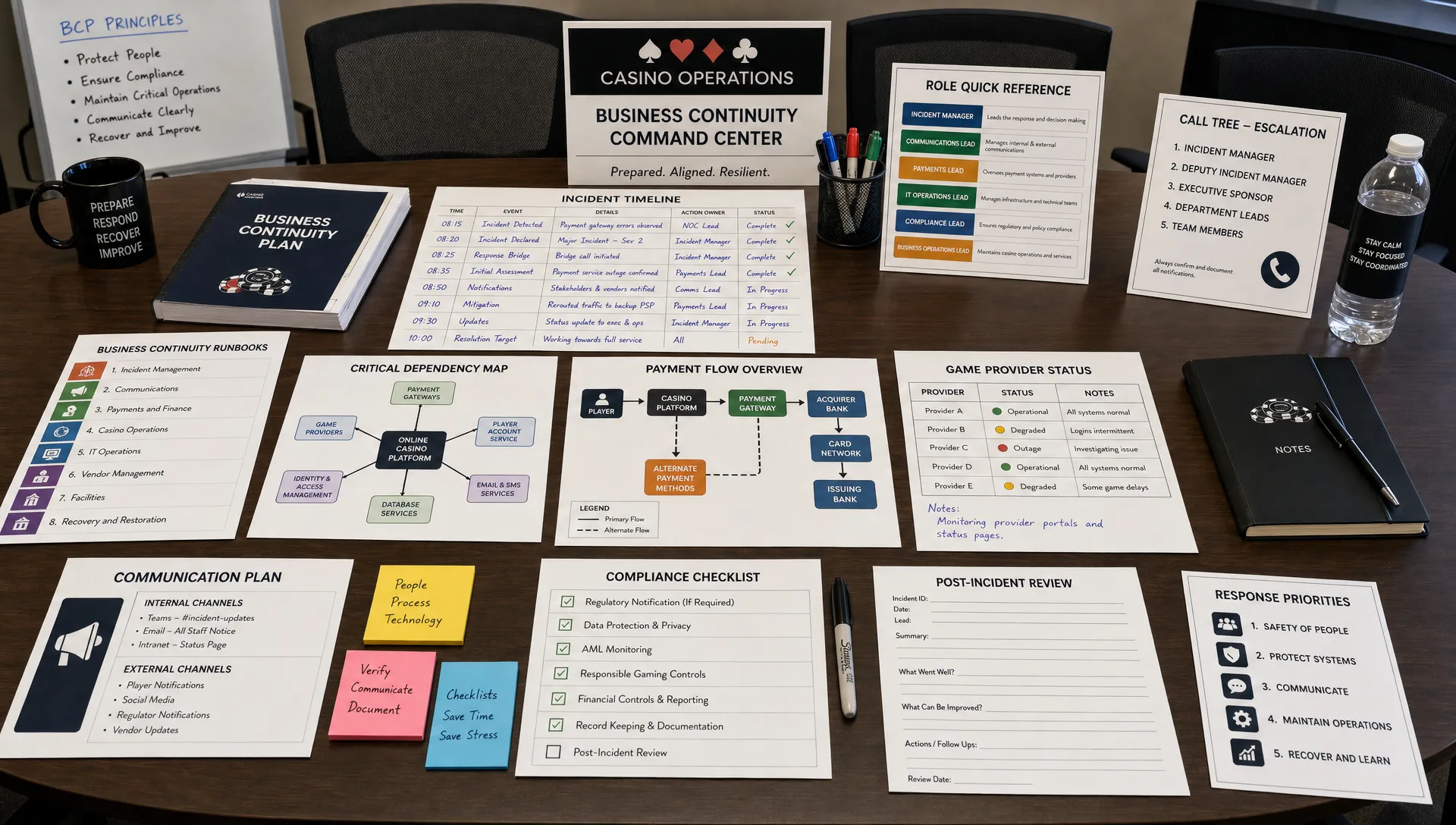
Build scenarios around capabilities, not panic
A weak BCP lists disasters. A strong BCP builds reusable capabilities for the disruptions most likely to hit a casino operation.
Common casino continuity scenarios include payment processor outages, game supplier downtime, cloud region instability, DDoS attacks, KYC vendor failures, delayed blockchain confirmations, fraud spikes, bonus abuse incidents, data pipeline failures, staff access problems, and regulatory restrictions that require immediate market or product changes.
Do not create a separate 40-page plan for every possible event. Instead, group scenarios by the capability needed to survive them. If multiple incidents require the ability to pause a payment method, communicate with affected players, reconcile transactions, and notify compliance, build that capability once and test it repeatedly.
This approach makes the plan easier to maintain. It also helps teams act faster because they are not searching for the perfect scenario document while an outage is already damaging player trust.
Define continuity strategies for each operational layer
Once the priorities are clear, define how each layer of the casino will continue operating. The best strategy is not always instant failover. Sometimes the safest continuity move is to block a function, queue a transaction, disable a game category, or stop promotional traffic until the operator can verify integrity.
| Operational layer | Continuity strategy | Example decision |
|---|---|---|
| Platform and hosting | Redundancy, scaling rules, tested recovery paths | Move traffic, enter degraded mode, or pause high-risk features |
| Payments | Multiple providers, payment method controls, reconciliation process | Disable a failed method and route players to alternatives |
| Crypto operations | Wallet monitoring, confirmation rules, onramp fallback process | Increase confirmation requirements or pause withdrawals |
| Game aggregation | Supplier status checks, game disable controls, round reconciliation | Remove affected slot games or live casino tables temporarily |
| Compliance | Backup access to KYC, AML, and responsible gambling records | Restrict withdrawals or deposits until checks are restored |
| Support | Incident scripts, escalation channels, player status updates | Give agents verified language and refund escalation rules |
| Marketing and affiliates | Campaign pause process, bonus freeze controls | Stop acquisition traffic during cashier instability |
For operators using a turnkey casino solution or white label casino platform, this step should be part of vendor evaluation. Ask how the provider supports degraded modes, payment controls, game supplier outages, manual review workflows, and admin access during incidents. If continuity depends on a single vendor response queue, the business has a concentration risk.
Assign decision rights before the incident
During a major outage, the worst question is, “Who is allowed to decide?” Your BCP should clearly assign authority for high-impact actions.
Define an incident commander or business continuity lead who coordinates the response across technical, operational, compliance, and commercial teams. This person does not need to fix every system. Their role is to keep decisions moving, maintain a single source of truth, and prevent conflicting actions.
You should also define named owners for platform operations, wallet and payments, fraud, compliance, customer support, marketing, affiliate management, legal communications, and vendor coordination. For each role, include backup owners. A continuity plan that depends on one person being awake, available, and authorized is not a continuity plan.
Decision rights should cover actions such as pausing deposits, freezing withdrawals, disabling a game supplier, putting bonuses on hold, limiting new registrations, contacting regulators, publishing player updates, activating backup vendors, and escalating to executive leadership.
Write playbooks that operators can actually use
A BCP fails when it reads like policy but not like action. Every critical workflow should have a short playbook with triggers, owners, steps, evidence requirements, and rollback conditions.
Useful casino continuity playbooks include:
- Cashier outage playbook for failed deposits, withdrawals, PSP routing, and player messaging
- Wallet discrepancy playbook for balance mismatches, duplicate transactions, and reconciliation freezes
- Game supplier outage playbook for incomplete rounds, disabled games, and supplier escalation
- KYC vendor outage playbook for registration limits, withdrawal review, and compliance logs
- Fraud spike playbook for account locks, bonus freezes, and manual risk review
- Crypto transaction delay playbook for confirmations, wallet monitoring, and support responses
Keep these playbooks in a location that remains accessible during normal tooling disruption. If the plan is stored only in the same system that is down, it will not help the team.
Plan communications by audience
Player trust is often won or lost in the first 30 minutes of a disruption. Communications should be fast, accurate, and consistent. They should also avoid overpromising before teams know the facts.
Create message templates for players, customer support, affiliates, payment partners, game suppliers, regulators, and internal leadership. Each audience needs a different level of detail. Players need to know what is affected, whether funds are safe, what actions they should avoid, and when the next update will come. Customer support needs approved language and escalation rules. Regulators may need formal notification depending on market requirements.
Avoid technical speculation in public messages. A phrase like “some withdrawals are delayed while we verify transaction status” is safer than blaming a provider before the facts are confirmed. If security may be involved, coordinate communications with legal and incident response owners before publishing details.
Protect compliance continuity
Compliance cannot be paused just because systems are under stress. If responsible gambling exclusions, deposit limits, AML checks, or KYC controls are unavailable, the safest continuity decision may be to restrict affected actions until controls are restored.
New operators should design this from the beginning rather than bolt it on later. A well-structured casino compliance stack makes continuity easier because obligations, controls, records, and escalation paths are already defined.
Your BCP should specify which actions fail open and which fail closed. In iGaming, many high-risk controls should fail closed. For example, if self-exclusion status cannot be checked reliably, allowing unrestricted play may create serious harm and regulatory exposure. If AML screening is unavailable, withdrawals above defined thresholds may need manual review or temporary delay.
Manage third-party dependency risk
Most casino outages are not purely internal. Your continuity plan should include the vendors that support your online casino, including platform providers, cloud services, payment processors, crypto onramp partners, game aggregators, KYC vendors, SMS and email providers, analytics tools, fraud systems, and customer support platforms.
For each critical vendor, document support channels, escalation contacts, service commitments, data access options, maintenance windows, regional dependencies, and fallback procedures. Do not wait until an outage to discover that a supplier has no weekend escalation path or that a payment provider cannot export transaction status quickly.
If you operate multiple brands, vendor dependency mapping becomes even more important. A shared provider can create efficiency, but it can also create correlated failure. One KYC provider outage or one game aggregator issue may affect every brand at once.
Test the plan with realistic drills
A BCP that has never been tested is only a draft. Testing reveals missing access, unclear decisions, outdated contact lists, broken assumptions, and gaps between technical recovery and business operations.
Use a mix of tabletop exercises and live operational drills. Tabletop exercises are useful for decision-making and role clarity. Live drills are useful for verifying that controls, access, alerts, exports, and fallback processes actually work.
| Test type | Suggested cadence | What to validate |
|---|---|---|
| Contact and access check | Monthly | Owners, backups, vendor contacts, emergency permissions |
| Tabletop scenario | Quarterly | Decisions, communication flow, escalation timing |
| Payment continuity drill | Quarterly | PSP routing, cashier messaging, reconciliation evidence |
| Game supplier outage drill | Twice per year | Game disable controls, round handling, supplier escalation |
| Full BCP exercise | Annually | Cross-team coordination, executive decisions, audit trail |
After every test, create a short after-action report. Track what worked, what failed, who owns each fix, and when it will be retested. The improvement loop is more important than the exercise itself.
Keep the BCP current as the casino scales
Business continuity planning is not a launch checklist that gets filed away. It should change when the casino changes.
Update the plan whenever you add a new market, license, payment provider, crypto asset, cloud region, game supplier, bonus mechanic, affiliate channel, support vendor, or major platform integration. Also update it after real incidents, failed tests, staffing changes, or regulatory changes.
For a modular iGaming platform, continuity should be part of the operating rhythm. The backoffice, analytics, fraud tooling, payment controls, game aggregation, KYC and AML workflows, and API integrations all affect how quickly the business can detect disruption and respond safely.
The strongest operators treat continuity as a competitive advantage. Players may never read your BCP, but they experience it when deposits are handled cleanly, balances remain accurate, support agents have answers, and the casino communicates calmly under pressure.
Frequently Asked Questions
What is the difference between a casino business continuity plan and a disaster recovery plan? A business continuity plan explains how the casino keeps operating during disruption, including people, vendors, communications, compliance, and commercial decisions. A disaster recovery plan focuses more narrowly on restoring systems, data, and infrastructure.
Who should own the casino business continuity plan? Ownership usually sits with operations, risk, or executive leadership, but the plan must be shared across technology, payments, compliance, support, marketing, legal, and vendor management. The owner coordinates the plan, while each function owns its continuity procedures.
How often should an online casino test its BCP? Critical contact lists and access should be checked monthly, tabletop exercises should run at least quarterly, and a full business continuity exercise should happen at least annually. High-risk areas such as payments and game supplier outages deserve more frequent testing.
What casino systems should be prioritized first? Wallet and ledger integrity, authentication, payments, game round handling, KYC, AML, responsible gambling controls, and customer support should usually be prioritized first because they directly affect money, player safety, and regulatory obligations.
Do crypto-ready casinos need a different continuity plan? They need the same core plan, plus crypto-specific procedures for wallet monitoring, confirmation delays, network congestion, custody access, onramp outages, withdrawal controls, and player communications around transaction status.
Build continuity into the platform from day one
A casino business continuity plan is much easier to execute when the underlying platform is built for control, visibility, and fast operational changes.
Spinlab provides a modular, crypto-ready iGaming platform for launching and scaling online casinos, with support for fiat and crypto payments, game aggregation, KYC and AML workflows, fraud prevention, analytics, affiliate and bonus tools, customizable backoffice controls, and open API integration. If you are building a new casino brand or replacing a fragile stack, start with a platform that makes continuity part of everyday operations, not an emergency afterthought.