

Chargeback alerts are most valuable when they stop being a mailbox and start becoming an operating system. For online casino operators, a cardholder dispute can be the visible end of a much longer chain: a confusing billing descriptor, a delayed withdrawal, a bonus misunderstanding, account takeover, card testing or a player trying to recover losses through friendly fraud.
A good early warning system does more than react to a bank notification. It connects payment gateway data, KYC status, fraud signals, support conversations, gameplay activity and refund decisions into one workflow. That is what lets an iGaming team act while the case is still preventable, instead of waiting until chargeback fees, monitoring ratios and lost revenue have already landed.
This guide explains how to build chargeback alerts for an online casino or whitelabel casino platform, from signal design to routing rules, dashboards and operational ownership.
What Chargeback Alerts Actually Do
A chargeback alert is a pre-dispute or early dispute signal that gives a merchant a short window to resolve a cardholder complaint before it becomes a formal chargeback, or before it escalates further in the dispute lifecycle. Alerts may come through an acquirer, payment service provider, fraud vendor or network-connected service.
In the card ecosystem, services such as Mastercard Ethoca Alerts and Visa Verifi dispute solutions are designed to help merchants receive issuer-side signals and respond faster. Exact availability, rules and response windows depend on the acquiring setup, region, card network and provider configuration.
For an online gambling platform, the alert itself is only one piece of the control. The operator still needs to decide whether to refund, contact the player, investigate fraud, preserve evidence or prepare for representment. A payment alert that is not connected to player history will create slow manual work. A payment alert enriched with casino context can become a genuine early warning system.
| Alert source | What it can reveal | Practical response |
|---|---|---|
| Network or issuer pre-dispute alert | The cardholder has contacted the bank or is likely to dispute | Review the account, refund if appropriate, resolve confusion or prepare evidence |
| Payment gateway anomaly | Failed deposits, duplicate attempts, suspicious card behavior or acquirer issues | Step up verification, throttle attempts or route to manual review |
| Support and complaint signals | Player frustration before they call the bank | Prioritize support, clarify withdrawal or bonus status and document the interaction |
| KYC and withdrawal friction | A dispute risk caused by delays, missing documents or unclear communication | Escalate the case and keep the player informed with compliant messaging |
| Linked fraud cluster | Device, card, IP, affiliate or bonus links to prior disputes | Pause risky actions, investigate and retain evidence |
Crypto adds another layer. Native crypto transactions do not carry traditional card chargeback rights, but many crypto-ready casinos still use card-based fiat deposits, third-party crypto onramps or multi-currency payment flows. If a player buys crypto through a card onramp and then funds a casino account, dispute risk may still exist somewhere in the payment chain. That means crypto support reduces some payment risks but does not remove the need for alerting.
Why Chargeback Alerts Matter More in iGaming
In retail, a dispute often relates to a product shipment, subscription renewal or refund delay. In iGaming, money can be deposited, wagered and withdrawn in a short period of time. By the time a chargeback appears, the player may have used a bonus, completed wagering requirements, lost funds, requested a withdrawal or moved between accounts.
That speed changes the risk model. A simple refund queue can accidentally reward abuse if it ignores gameplay and account links. A strict no-refund approach can also be costly if the issue is really a duplicate deposit, a confusing descriptor or a support failure. The right answer depends on the context.
Common chargeback triggers in online casinos include unfamiliar billing descriptors, failed or duplicated deposit attempts, withdrawal delays, KYC requests after a win, unauthorized account access, bonus term disputes and buyer’s remorse after losses. Coordinated fraud groups may also use stolen cards, mule accounts, linked devices and affiliate campaigns to create chargeback exposure at scale.
For a broader view of prevention across the player journey, Spinlab has a dedicated guide to casino chargebacks for product teams. The alert system described here focuses on the operational layer: how to detect the risk early, route it to the right owner and close the loop with data.
The Data Foundation: One Transaction ID Is Not Enough
The most common chargeback alert failure is poor matching. The alert arrives with partial payment data, but the risk team has to search across the gateway, backoffice, KYC provider, CRM, game aggregator and support tool to understand what happened. That delay can be enough to miss the response window.
An early warning system needs a shared case record. Every deposit should be traceable across payment, player and product activity. At minimum, the platform should make it easy to join these fields without exposing unnecessary personal data to every team member.
| Data category | Fields that matter for alert handling |
|---|---|
| Payment | Payment ID, gateway transaction ID, amount, currency, payment method, descriptor, card token or fingerprint, 3DS result, decline history and refund status |
| Player account | User ID, registration date, country, KYC status, AML review status, phone and email verification, prior alerts and prior disputes |
| Session and device | Device ID, IP, VPN or proxy signal, geolocation, login history, password or email changes and account takeover indicators |
| Casino activity | Game sessions, bonus ID, wagering progress, deposits after bonus claim, withdrawal requests and game provider activity |
| Support and CRM | Tickets, chat tags, complaint categories, promised actions, email delivery and player communication history |
| Risk links | Shared card token, shared device, shared wallet, linked affiliate, linked IP, previous refund behavior and negative list matches |
This structure does not mean every employee should see everything. Chargeback workflows should respect privacy, role-based access and local regulatory requirements. The goal is to give each owner enough context to make the right decision fast.
Building the Alert Logic
A useful chargeback alert program combines three layers: reactive alerts from payment sources, predictive alerts from internal behavior and operational health alerts that warn the team when the platform itself is creating dispute risk.
Reactive alerts are the most familiar. A network, issuer, acquirer or payment gateway sends a signal that a transaction is under dispute pressure. The system should instantly enrich the alert with account status, deposit history, wagering activity, KYC state and support interactions.
Predictive alerts happen before the bank is involved. These are triggered by internal patterns that often precede disputes. Examples include a player opening multiple withdrawal-delay tickets, a successful deposit after a burst of failed card attempts, a first-time depositor using a device linked to previous chargebacks or a player who changes login credentials shortly before high-risk payment activity.
Operational health alerts track the conditions that create avoidable disputes. If a payment descriptor changes, a withdrawal queue slows down, KYC reviews exceed target response times or a cashier integration starts creating duplicate attempts, the chargeback team should know before the complaint volume reaches the banks.
A simple severity model can start with clear rules, then improve as the team gathers outcome data.
| Condition | Suggested severity | Why it matters | First action |
|---|---|---|---|
| Clean player asks about an unfamiliar descriptor | Low | Likely confusion rather than fraud | Send receipt details and descriptor explanation |
| Successful deposit follows repeated failed attempts | Medium | Could be normal friction or card testing behavior | Review velocity, device and payment method risk |
| Withdrawal delay plus angry support ticket | High | Player may go to the issuer if support feels slower than the bank | Prioritize review and communicate next steps |
| Device or card token linked to prior chargebacks | High | Strong repeat-risk signal | Escalate to fraud review and preserve evidence |
| Network pre-dispute alert on a recently wagered deposit | Critical | Short response window and direct financial exposure | Triage immediately, decide refund or evidence path |
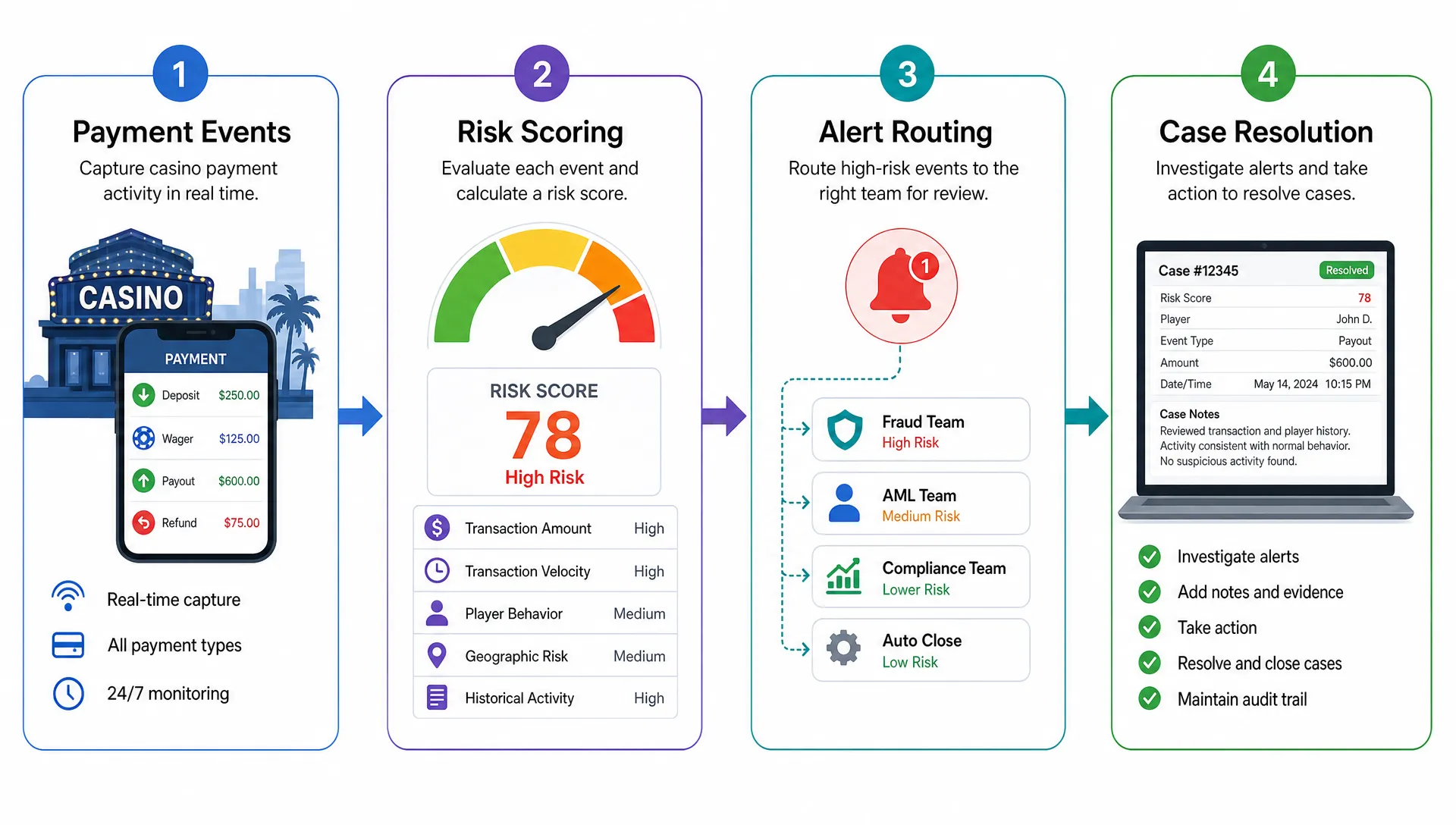
Routing: What Should Happen When an Alert Fires
Alerts fail when ownership is vague. A good system assigns each alert class to a primary owner, defines the internal SLA and limits the actions that can be taken without review. Payments, fraud, support, KYC and compliance may all touch the same case, but one queue must own the clock.
| Alert class | Primary owner | Target response | Possible outcome |
|---|---|---|---|
| Network pre-dispute alert | Payments or risk operations | Same business day, or faster if provider rules require it | Refund where appropriate, resolve confusion or prepare evidence |
| Descriptor confusion | Support with payments visibility | Immediate customer response | Send receipt, explain descriptor and confirm transaction details |
| Duplicate deposit complaint | Payments operations | High priority | Verify settlement, reverse duplicate if confirmed and document the fix |
| Withdrawal or KYC frustration | Support, KYC and risk | Priority escalation | Clarify status, remove internal blocker or provide compliant explanation |
| Account takeover pattern | Fraud and security | Immediate | Secure the account, step up authentication and investigate payment exposure |
| Linked bonus or affiliate abuse | Fraud operations | Before payout or refund decision | Apply permitted controls, review linked accounts and retain evidence |
The most sensitive decision is whether to refund. Refunding every alert may lower formal chargebacks in the short term, but it can teach organized fraud groups that the casino is easy to monetize. Fighting every alert may protect individual deposits while pushing the operator into higher dispute ratios and higher operating cost.
A practical decision should weigh transaction amount, player value, KYC status, gameplay after deposit, withdrawal status, previous disputes, device links, support context and the specific reason for the alert. If the evidence is strong and the case becomes a formal dispute, the team should already have a clean evidence file. Spinlab’s guide to chargeback representment for casinos goes deeper on what to preserve and how to structure that file.
Automating Without Creating New Risk
Automation should reduce response time, not remove judgment from cases that need it. The safest pattern is to automate enrichment, routing, task creation and low-risk communication, while keeping refund approvals, account restrictions and evidence submission under controlled permissions.
Useful automations include case creation when an alert arrives, automatic matching to player and payment records, tagging based on severity, support task assignment, duplicate deposit checks and standardized receipt messaging. Operators can also automate risk holds that are allowed under their terms and local regulation, but those controls should be reviewed carefully by compliance and legal teams.
Be careful with player messaging. A chargeback alert is not a reason to threaten the player or pressure them to give up a valid consumer right. Good communication is factual: confirm the merchant descriptor, explain the deposit status, clarify any withdrawal or KYC requirement and give the player a fast path to support.
This is also where platform design matters. If the backoffice, payment gateway, KYC tools and analytics are disconnected, even a strong alert feed turns into copy-paste operations. On a modern iGaming platform, the alert should open a case that already contains the payment, account, device, bonus and support context needed to act.
Metrics for a Weekly Chargeback Alerts Dashboard
A chargeback alert program improves only if the team measures outcomes. The dashboard should separate volume from effectiveness. A rising alert count is not always bad if it means better coverage. A falling alert count is not always good if the operator simply stopped receiving useful signals.
| Metric | What it answers | How to use it |
|---|---|---|
| Alert volume by provider and payment method | Where alerts are coming from | Spot gaps in coverage or noisy sources |
| Match rate | How often alerts connect to the correct player and payment | Fix data quality, descriptor or gateway mapping issues |
| SLA compliance | Whether the team responds before windows close | Staff queues and automate triage steps |
| Chargeback conversion after alert | How many alerted cases still become disputes | Test whether actions are actually preventing chargebacks |
| Refund save rate | How often refunds prevent formal disputes | Compare refund cost against chargeback fees and monitoring risk |
| Repeat alert rate | Whether the same player, device or affiliate keeps appearing | Detect organized abuse or support process failures |
| Reason code mix | Why disputes are being filed | Prioritize product, payment or communication fixes |
| Net loss per alert category | Which alert types cost the most | Tune rules and escalation thresholds |
A weekly review should include payments, fraud, product, support and compliance. If the same issue appears repeatedly, the fix may belong outside the alert queue. For example, descriptor confusion is a payments and communication problem. Withdrawal frustration is a product and support problem. Multi-account abuse is a fraud controls problem.
Spinlab’s casino fraud KPI dashboard template can be used alongside chargeback alert reporting, especially when the same signals affect payments, bonus abuse, account takeover and compliance risk.
Common Implementation Mistakes
The first mistake is treating alerts as a finance-only issue. Chargebacks touch the cashier, bonus engine, KYC flow, withdrawal process, support scripts and fraud tooling. If the alerts sit only with accounting, the root cause will keep producing new cases.
The second mistake is poor descriptor discipline. Players often do not recognize the legal entity, payment processor or billing name that appears on their statement. Receipts, cashier pages and support macros should show the descriptor clearly so legitimate players do not call their bank out of confusion.
The third mistake is ignoring failed deposits. A chargeback may appear on the successful transaction, but the warning signs may be in the failed attempts that came before it. Repeated declines, rapid card switching and mismatched countries are often more useful than the final approved payment alone.
The fourth mistake is over-refunding. Refunds can be the right operational choice, especially for duplicates or genuine merchant errors, but a blanket refund rule can attract abuse. The decision should be tied to risk context, not just the presence of an alert.
The fifth mistake is failing to retain evidence. Even when the team chooses to refund, the case should be documented. The same player, device, card token, wallet or affiliate may appear again. Good historical data makes the next alert easier to judge.
A Practical Rollout Plan
You do not need a machine learning program to start. Most operators can reduce dispute pressure with clean data, clear ownership and a few high-signal rules.
- Weeks 1 to 2: Map every payment method, descriptor, gateway ID and refund path. Confirm which alert sources are available through your acquirer, payment gateway and fraud vendors.
- Weeks 3 to 4: Create a chargeback alert case schema. Include player ID, payment ID, KYC status, device risk, bonus status, support history, owner, SLA and outcome.
- Month 2: Launch severity rules for the highest-risk scenarios: network alerts, duplicate deposit complaints, withdrawal-delay complaints, linked chargeback devices and repeated failed card attempts.
- Month 3: Automate enrichment and routing. Move from inbox handling to case management, with dashboards for SLA compliance, conversion after alert and net loss.
- Ongoing: Review outcomes weekly. Remove noisy rules, strengthen high-performing signals and route recurring root causes to product or payments teams.
This rollout also works for a new white label casino platform. In fact, launching with alert workflows from day one is easier than adding them after dispute ratios become a problem.
Where Spinlab Fits
Spinlab is built for operators that need a modular, all-in-one iGaming platform for launching and scaling online casinos. Because chargeback alerts depend on connected data, platform architecture matters as much as the alert feed itself.
Spinlab supports crypto and fiat payments, KYC and AML compliance, advanced fraud prevention, a customizable backoffice, real-time analytics, multi-currency support, open API integration and game aggregation. Those components give operators the foundation to connect payment events with player activity, support workflows and fraud signals instead of handling disputes in isolated tools.
For teams building a whitelabel casino or replacing fragmented casino software, the goal is not just to add alerts. The goal is to make alerts actionable inside the same operating environment where deposits, verification, bonuses, withdrawals and risk reviews already happen.
Frequently Asked Questions
What is a chargeback alert? A chargeback alert is an early signal that a cardholder dispute may happen or has started. It gives the merchant a chance to respond quickly, often by resolving confusion, issuing a refund where appropriate or preparing evidence.
Do chargeback alerts prevent all casino disputes? No. They reduce preventable chargebacks, but they do not replace strong fraud controls, clear payment descriptors, fair bonus terms, reliable KYC processes and good support. They work best as part of a layered risk system.
Should an online casino refund every chargeback alert? Not automatically. Refunds may make sense for duplicates, genuine processing errors or low-evidence cases, but blanket refunds can encourage abuse. The decision should use account history, gameplay, KYC status, device links and dispute reason.
Are chargeback alerts useful for crypto casinos? Yes, if the casino also accepts cards, fiat deposits or card-based crypto onramps. Native crypto transactions do not work like card chargebacks, but fiat rails and onramp providers can still create dispute exposure.
What team should own chargeback alerts? Payments or risk operations usually owns the queue, but support, KYC, compliance, fraud and product teams need defined roles. The key is one accountable owner for response time and a shared workflow for investigation.
Build Chargeback Alerts Into the Platform, Not Around It
Chargeback alerts are only useful when they connect to the real player journey. If your team is switching between payment dashboards, KYC tools, support tickets and spreadsheets, the warning is already too slow.
Spinlab helps online casino operators build on a connected, crypto-ready and fiat-ready platform with payments, compliance, fraud prevention, analytics and backoffice tools designed for scale. If you are launching a whitelabel casino or modernizing your current stack, explore Spinlab and build dispute prevention into the platform from the start.