

For an online casino, support is part of the product. Players judge trust in the moments where money, identity, access or fairness feels uncertain: a deposit is approved by the bank but missing from the balance, a withdrawal is pending longer than expected, a KYC review blocks gameplay or a game round does not settle correctly.
A support SLA is useful only if it measures those moments from the player's point of view. Internal promises like "we answer tickets within 24 hours" may satisfy a contract, but they do not always reduce anxiety. The better question is: did the player get a clear answer, at the right time, from someone who could actually move the issue forward?
For casino operators, the most valuable SLA metrics connect customer support to payments, compliance, game operations, fraud prevention and platform observability. They do not only show whether agents are busy. They show whether the business is protecting player confidence.
Why casino support SLAs need trust metrics
A generic customer service SLA measures speed. A casino support SLA measures speed under risk.
That difference matters because casino support often touches regulated workflows. A player asking about a delayed withdrawal is not the same as a retail shopper asking about shipping. The answer may depend on payment gateway status, wallet risk checks, KYC verification, bonus abuse review, AML monitoring or game provider settlement data.
Regulators also expect operators to handle customer interactions and complaints consistently. In the UK, for example, the Gambling Commission's Licence Conditions and Codes of Practice sets expectations around fair and open terms, complaints and safer gambling obligations. Other markets have their own rules, but the operational lesson is the same: support quality is not just a brand issue, it can become a compliance issue.
Trust-focused SLAs help teams answer three practical questions:
- Can players get help quickly when money or account access is involved?
- Can the support team see enough platform data to explain what happened?
- Can managers spot recurring product friction before it becomes a reputation problem?
If you are also evaluating the vendor side of the relationship, Spinlab has a separate guide on how to evaluate casino platform support and SLAs. This article focuses on the metrics an operator should run internally to improve the player experience.
Start by classifying support issues by trust risk
Not every support ticket deserves the same SLA. A typo in a promotional email and a locked account with pending funds should not sit in the same queue.
A useful model separates tickets by player trust risk, not only by department. The classification should be simple enough for agents to use consistently and precise enough for managers to audit.
| Severity | Typical casino examples | Player trust risk | SLA focus |
|---|---|---|---|
| P0, critical incident | Platform outage, payment gateway outage, widespread wallet balance issue, live casino unavailable across a major market | Many players affected at once, public complaints likely | Fast incident acknowledgement, status updates and resolution coordination |
| P1, high trust risk | Deposit debited but not credited, withdrawal blocked without explanation, account locked with balance, KYC review stopping access | Player believes funds or access are at risk | First qualified response, clear next step and frequent updates |
| P2, medium trust risk | Bonus dispute, game round settlement question, document resubmission, failed login for one player | Friction may escalate if unclear | Accurate resolution and low repeat contact |
| P3, low urgency | General promo question, game availability request, account preference update | Low immediate risk | Efficient response and self-service improvement |
This severity model does not replace fraud or compliance review. It makes sure those workflows are communicated clearly. For example, a withdrawal under review may require additional checks, but the player should not be left guessing whether the request was lost.
The casino support SLA metrics that improve player trust
The best SLA dashboard uses a mix of speed, quality and prevention metrics. Speed matters, but a fast empty reply can make things worse. Quality matters, but a correct answer that arrives too late may still feel unfair.
First qualified response time
First response time is a common support metric, but casinos should measure the first qualified response. A qualified response confirms the issue type, explains what is known, gives the next step and avoids pretending the case is solved when it is only acknowledged.
For trust-sensitive queues, a bot acknowledgement should not count unless it gives useful status. "We received your ticket" is not the same as "Your withdrawal is pending KYC document review, and our payments team will review the uploaded document next."
Track first qualified response at the median, 90th percentile and 95th percentile. The average is too forgiving because a small group of severely delayed cases can create the public complaints that damage trust.
Time to meaningful update
Many casino disputes escalate because of silence. A player may accept a review if the process is visible, but repeated generic replies create suspicion.
A meaningful update should include one or more of the following:
- Current status of the case
- Team or workflow responsible for the next action
- Information needed from the player
- Reason for delay if known
- Next expected update window
This metric is especially useful for withdrawals, KYC reviews, chargeback investigations and game provider escalations. Measure the time between meaningful updates, not the number of agent touches.
Time to resolution by outcome
Resolution time should be measured by case type and final outcome. A payment issue resolved by crediting a balance is different from a bonus dispute closed because the terms were correctly applied.
Use outcome tags such as "player action required," "operator action completed," "provider escalation resolved," "fraud review completed," "duplicate ticket merged" or "policy explanation accepted." These tags help managers see where slow resolution is caused by support capacity, missing data, provider dependency or unclear product flows.
Repeat contact rate
Repeat contact rate measures how often a player contacts support again about the same issue within a defined window, such as 7 days. It is one of the clearest signs that the first answer did not build confidence.
For casino operators, repeat contact should be segmented by issue type. A high repeat rate on withdrawals may point to poor status messaging. A high repeat rate on bonuses may reveal confusing terms. A high repeat rate on login or MFA problems may show account recovery friction.
Spinlab's guide on reducing withdrawal support tickets covers this idea in more depth: the best support ticket is often the one prevented by a clearer product experience.
Reopen rate
A low resolution time is not impressive if players reopen cases. Reopen rate shows whether tickets are being closed too early, routed incorrectly or answered without enough context.
This metric should be reviewed alongside agent quality scores. If reopen rate rises while resolution time falls, managers may be rewarding speed at the expense of trust.
Escalation accuracy
Casino support depends on handoffs. Agents may need help from payments, risk, compliance, game operations, VIP teams or the platform provider. Escalation accuracy measures whether cases are sent to the right team with the right information on the first attempt.
Poor escalation accuracy creates internal ping-pong and player frustration. It also hides the true reason for delay because the case appears "in progress" even though nobody owns the next step.
A useful escalation should include player ID, transaction ID if relevant, payment method, market, device, game provider if relevant, risk flags visible to support, previous replies and the exact decision needed.
Contact rate per transaction or session
Ticket volume alone can mislead. A growing casino will naturally receive more support requests. Contact rate normalizes support demand against player activity.
Useful examples include tickets per 1,000 deposits, tickets per 1,000 withdrawals, tickets per 1,000 KYC submissions, tickets per 10,000 game rounds and tickets per 1,000 bonus activations.
This metric connects support to product operations. If tickets per 1,000 deposits spike for one payment gateway, the issue is not agent productivity. It is a payments or integration problem that support is absorbing.
| Metric | How to measure | Why it improves trust | Common mistake |
|---|---|---|---|
| First qualified response time | Time from ticket creation to a useful first answer | Shows the player the issue is understood | Counting auto-replies as real responses |
| Time to meaningful update | Time between updates that explain status or next action | Reduces anxiety during reviews or outages | Sending repeated generic messages |
| Time to resolution by outcome | Time from case creation to final tagged outcome | Reveals where workflows break down | Mixing simple questions with complex investigations |
| Repeat contact rate | Same player, same issue category within a set window | Shows whether answers were clear enough | Measuring only total ticket volume |
| Reopen rate | Reopened cases divided by resolved cases | Finds premature closures and weak answers | Rewarding low handle time without quality checks |
| Escalation accuracy | Correct team and complete data on first escalation | Reduces internal delays | Escalating vague tickets without transaction context |
| Contact rate per activity | Tickets divided by deposits, withdrawals, sessions or KYC submissions | Finds product friction before trust erodes | Treating all volume growth as a staffing issue |
Metrics for payment and withdrawal support
Payment support is where player trust is won or lost fastest. A player who sees money leave their bank, card, crypto wallet or e-wallet but not appear in the casino balance needs a faster and clearer path than a generic ticket queue.
For deposits, track time from failed or pending transaction event to first player-visible explanation. The support team should be able to distinguish between bank decline, payment gateway timeout, duplicate attempt, fraud step-up and delayed wallet confirmation. The player does not need every internal detail, but they do need a credible explanation.
For withdrawals, avoid measuring only "time to cashout" as a support SLA. That can push teams to bypass necessary checks. A better metric is time to decision or time to next required action. If the withdrawal is waiting for KYC, the SLA should measure how quickly the player is told exactly what document or action is needed. If it is under risk review, the SLA should measure whether updates are sent on schedule and whether the review has an owner.
Crypto-ready casinos should also separate on-chain confirmation delays from internal review delays. If a withdrawal is broadcast on-chain, support needs the transaction reference. If it is still in internal approval, the player should not be told to wait for blockchain confirmations.
Metrics for game and provider incidents
Players rarely care whether a failed spin, frozen round or missing live casino result was caused by the operator, the platform, the game aggregator or the studio. They expect the casino to own the explanation.
Useful SLA metrics for game incidents include time to detect abnormal error rate, time to suspend affected games if needed, time to publish a status update, time to provider escalation and time to player settlement after confirmation.
This is where observability matters. If support has no link between tickets, game sessions, provider events and wallet transactions, agents can only guess. A strong monitoring setup should connect metrics, traces and alerts across the player journey. Spinlab's article on observability for iGaming explains which platform signals help teams investigate incidents faster.
For public trust, the status communication SLA is as important as the technical resolution SLA. During a major outage, players should see timely status messages in the channels they actually use, such as the casino lobby, account area, email, SMS or support chat depending on market and consent rules.
Metrics for KYC, AML and account restrictions
KYC and AML workflows are sensitive because the operator may be unable to disclose every detail behind a review. That does not mean support should be silent or vague.
Measure time to first document review, time to rejection reason when a document fails, time to next action after resubmission and age of restricted accounts with balances. Segment these metrics by market and verification vendor if applicable.
For account restrictions, create separate SLAs for communication and investigation. The investigation may take longer due to fraud or compliance requirements. The communication SLA should still ensure the player receives a compliant explanation of status, available actions and any documents required.
A good rule: support should never promise an approval outcome, but it should be accountable for clarity, cadence and ownership.
Use percentiles instead of averages
Averages hide the cases that hurt trust. If 90 percent of payment tickets are answered quickly and 10 percent wait for days, the average may look acceptable while social media, forums and affiliate communities focus on the worst cases.
For each major SLA, track at least p50, p90 and p95. The median shows the normal experience. The 90th and 95th percentiles show whether the edge cases are under control.
You can also track breached cases by age bucket. For example, show how many P1 cases are older than 1 hour, 4 hours, 12 hours and 24 hours. This gives managers a live backlog view instead of a retrospective report after players have already lost patience.
Build a support SLA dashboard operators can act on
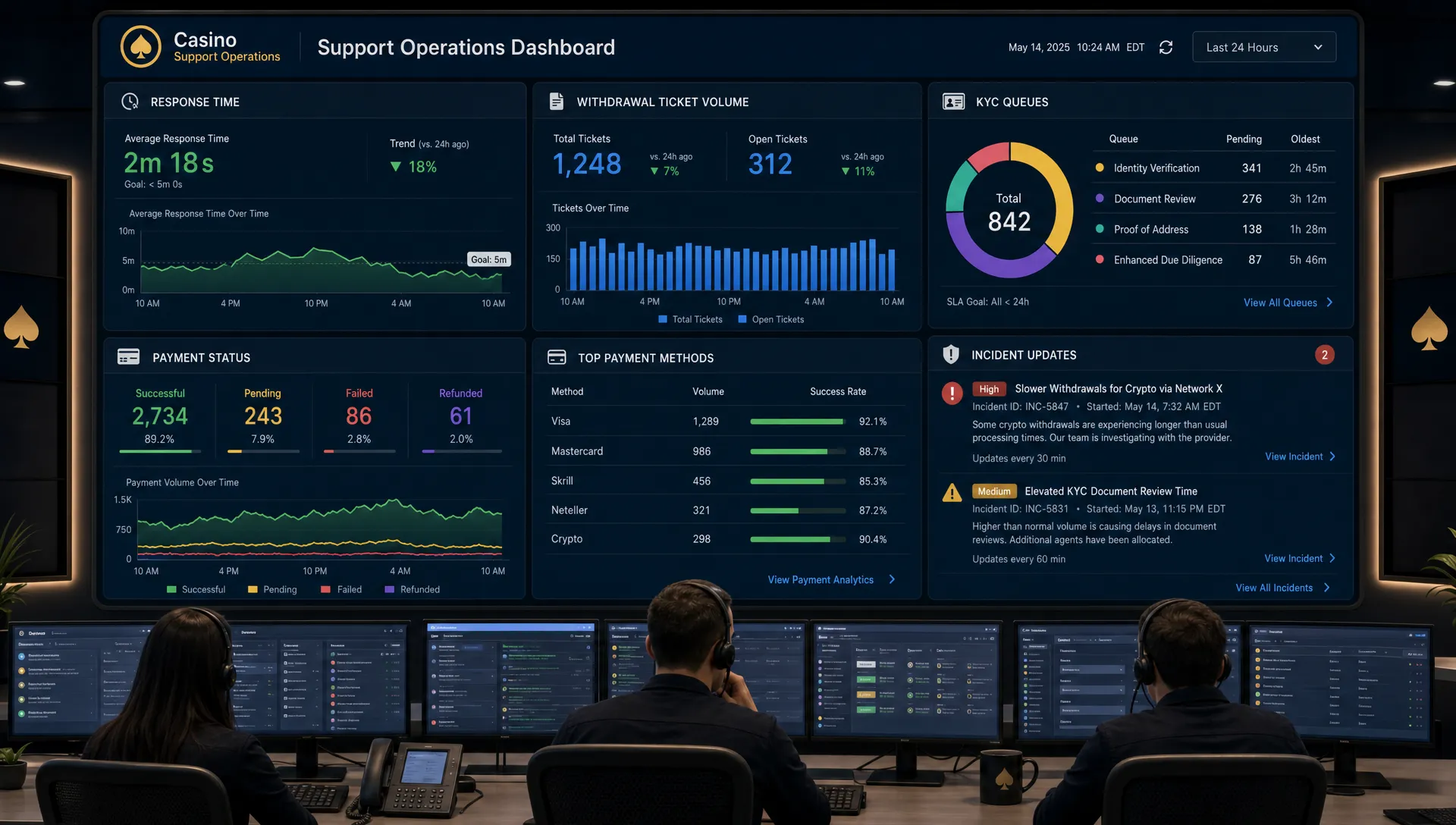
A casino SLA dashboard should not be a wall of vanity metrics. It should help daily operations decide what to fix next.
| Dashboard view | Primary audience | Best cadence | Decision it supports |
|---|---|---|---|
| Live breach queue | Support leads | Real-time | Which cases need immediate ownership |
| Payment friction view | Payments and support | Daily | Which gateway, method or market is creating contacts |
| KYC backlog view | Compliance and support | Daily | Where document review or resubmission is slowing players |
| Game incident view | Product, game operations and support | Real-time during incidents | Which provider or game needs escalation or messaging |
| Repeat contact review | Support QA and product | Weekly | Which answers, flows or policies create confusion |
| Complaint conversion trend | Operations and leadership | Weekly or monthly | Which support categories are becoming formal disputes |
This dashboard becomes more powerful when it is connected to player lifecycle data. New players, high-value players, bonus-active players and recently verified players may experience the same delay differently. Segmenting helps you understand impact, but support rules should still remain fair, auditable and compliant.
How to set SLA targets without creating bad incentives
Aggressive SLA targets can backfire if they reward the wrong behavior. If agents are measured only on first response time, they may send shallow replies. If they are measured only on resolution time, they may close cases too early. If payment teams are measured only on withdrawal speed, they may weaken risk controls.
The best approach is to pair every speed metric with a quality or safety metric. First response time should be paired with qualified response rate. Resolution time should be paired with reopen rate and repeat contact rate. Withdrawal decision time should be paired with fraud, chargeback and AML control metrics.
Targets should also differ by queue. A P1 payment issue needs faster communication than a general bonus question. A complex AML review may need a longer investigation window, but it still needs a communication cadence that prevents the player from feeling ignored.
Platform capabilities that make trust-focused SLAs possible
Support teams cannot meet strong SLAs if the platform hides the data they need. Casino operators should make sure agents and escalation teams can access the right operational context without unsafe data exposure.
Useful platform capabilities include real-time payment status, player wallet events, game round history, KYC status, bonus activity, fraud signals, market and currency details, provider incident alerts and audit logs. Role-based access also matters because support needs context without giving every agent unrestricted control over sensitive actions.
This is where an all-in-one iGaming platform can reduce friction. Spinlab brings together crypto and fiat payment support, game aggregation, KYC and AML compliance, fraud prevention, real-time analytics, a customizable backoffice and open API integration in a modular casino platform. That combination gives operators a stronger foundation for SLA reporting because support metrics can be connected to the workflows that create tickets in the first place.
Frequently Asked Questions
What is a casino support SLA? A casino support SLA is a measurable service promise for handling player issues, such as response time, update frequency, resolution time and escalation ownership. The best SLAs are segmented by issue severity because payment, KYC and account access cases carry higher trust risk than general questions.
Which support SLA metric matters most for player trust? First qualified response time is often the most visible metric, but it should be paired with time to meaningful update, repeat contact rate and reopen rate. Players trust support more when they receive clear answers, not just fast acknowledgements.
Should withdrawal SLAs promise a fixed payout time? Operators should be careful with fixed payout promises because withdrawals may require KYC, AML or fraud checks. A safer SLA measures time to decision, time to next required player action and update cadence during review.
How often should casino support SLA metrics be reviewed? Live breach queues should be monitored in real time. Payment, withdrawal and KYC friction should be reviewed daily. Repeat contact, reopen rate and complaint conversion trends are usually more useful in weekly management reviews.
How do support SLAs connect to casino retention? Players are more likely to return when they feel the operator handles money, access and disputes fairly. Strong SLAs reduce uncertainty during high-stress moments, which can protect retention even when the answer is not the one the player wanted.
Build support SLAs around the full player journey
Player trust is not created by a support inbox alone. It depends on payments, compliance, fraud prevention, game operations, analytics and clear communication working together.
If you are building or scaling an online casino, Spinlab provides a modular, crypto-ready iGaming platform with integrated payments, compliance tools, game aggregation, real-time analytics and a customizable backoffice. Use that operational foundation to turn support SLAs into a trust system players can feel in every critical moment.