

Casino player complaints are a stress test for your operation. A deposit that never arrives, a withdrawal hold that feels unexplained, a bonus term the player says was unclear or a disputed game round can quickly turn into public reviews, regulator attention, chargebacks or player churn.
A fair complaints process is not just a customer support policy. It is a workflow that connects support, payments, risk, compliance, game operations and product teams around one clear question: what happened, what does the evidence show and what is the fairest compliant outcome?
For online casino operators, the goal is not to approve every claim. The goal is to resolve complaints consistently, explain decisions clearly and leave an audit trail that can stand up to internal review, payment disputes and licensing scrutiny.
What Counts as a Casino Player Complaint?
Not every unhappy message is a formal complaint, but operators should avoid treating serious issues as ordinary support noise. A practical definition is simple: a complaint is any player communication that alleges the casino made an error, acted unfairly, failed to deliver funds or failed to follow its own terms.
Common casino player complaints include:
- Delayed withdrawals or payment failures
- Missing deposits, duplicate deposits or incorrect balances
- Bonus wagering disputes, excluded games or max bet breaches
- Disputed slot games, live casino games or interrupted rounds
- KYC, AML or source of funds frustration
- Account restrictions, closures or confiscated funds
- Self exclusion, cooling off or responsible gambling concerns
- Suspected account takeover or unauthorized activity
A good workflow separates complaints from routine questions early. “Where is my withdrawal?” may be a normal ticket on day one. “You are withholding my winnings without giving a reason” is a complaint and should enter a controlled process.
The Principles Behind Fair Resolution
Before building the workflow, define the operating principles. These keep decisions consistent when the facts are messy or the player is angry.
First, one system should hold the truth. Support chat, wallet transactions, KYC status, bonus history, game logs and risk notes should not live in disconnected silos. If teams work from different records, resolutions become slower and less reliable.
Second, the player should know what is happening. That does not mean exposing fraud rules, AML thresholds or proprietary risk logic. It does mean confirming receipt, explaining the review stage and giving realistic timeframes.
Third, decisions need evidence. A complaint outcome should not depend on which agent received the ticket or how loud the player became. Every decision should connect back to account history, transaction records, game provider logs, terms accepted by the player and applicable compliance requirements.
Regulators often expect operators to provide clear complaint channels and escalation routes. The UK Gambling Commission’s complaints and disputes guidance is a useful reference point, even if your casino operates outside Great Britain, because it reflects a broader regulatory expectation: players must have a fair way to challenge outcomes.
A Practical Workflow for Casino Player Complaints
The workflow below is designed for online casinos, whitelabel casino teams and operators using modular iGaming platform setups. It can be implemented in a support desk, backoffice or case management tool, as long as every stage is tracked.
1. Intake the Complaint and Create a Case Record
The first response sets the tone. Acknowledge the complaint quickly, assign a case ID and capture enough information to investigate without asking the player to repeat the same story across channels.
A useful intake record includes the player ID, complaint category, affected transaction or game round, date and time, communication channel, claimed loss or requested remedy, screenshots provided by the player and the agent who opened the case.
The acknowledgement should be plain and neutral. Avoid promising an outcome before review. A good response might say: “We have opened complaint case C-10458 regarding your withdrawal. Our payments team will review the transaction history and KYC status, and we will update you within 24 hours.”
This is also the moment to stop duplicate handling. If the player contacts live chat, email and VIP support about the same issue, those conversations should be attached to one case. Multiple unresolved threads increase the risk of inconsistent answers.
2. Triage by Category, Risk and Urgency
Triage decides who owns the case and how fast it needs attention. Payment issues may require PSP logs, bank settlement data or crypto transaction hashes. Bonus complaints need wagering history and terms snapshots. Game outcome disputes usually require game round IDs and provider confirmation.
Use a triage matrix that is simple enough for frontline teams to apply consistently.
| Complaint type | Primary owner | Typical evidence | Escalation trigger |
|---|---|---|---|
| Missing deposit | Payments | Cashier event, PSP status, ledger entry, bank or wallet reference | Funds debited from player but not credited after provider confirmation |
| Withdrawal delay | Payments and risk | Withdrawal timeline, KYC status, risk flags, payment rail status | Review exceeds published timeframe or player threatens regulator complaint |
| Bonus dispute | CRM or promotions | Bonus terms, opt in record, bet history, wagering progress | Terms ambiguity or material financial impact |
| Game round dispute | Game operations | Round ID, provider log, wallet debit and credit, session history | Provider log conflicts with casino ledger |
| Account restriction | Risk and compliance | KYC data, AML review notes, fraud signals, login history | Funds held, account closed or legal complaint risk |
| Responsible gambling | Compliance | Player messages, limits, self exclusion status, intervention records | Self exclusion failure or harm related allegation |
Triage should also identify high sensitivity complaints. Responsible gambling allegations, suspected underage gambling, account takeover, large withdrawal holds and repeated failed payments deserve faster escalation than a small bonus misunderstanding.
3. Freeze the Evidence Before It Changes
Once a complaint becomes formal, preserve the evidence. The goal is not to freeze the player’s whole account by default. The goal is to freeze the relevant case record so teams can reconstruct events accurately.
Evidence can change quickly. Bonus states expire, sessions close, game providers archive logs, PSP statuses update and risk teams add new notes. A reliable complaint workflow captures a timestamped snapshot of the facts as they stood when the complaint was opened.
For payment and balance complaints, the casino ledger matters more than almost anything else. Operators need a transaction history that shows deposits, bets, wins, reversals, adjustments, fees and withdrawals in sequence. If your team is still cleaning up manual wallet edits or unclear balance corrections, Spinlab’s guide to casino ledger audit trails, reversals and settlements is a useful companion to this workflow.
4. Assign Ownership and Set Internal Timeframes
Every complaint needs a single case owner, even if several departments contribute. Without ownership, cases drift between support, risk and payments with no one accountable for the final answer.
Timeframes should be realistic by category. A bonus complaint may be resolved in hours if all data is internal. A card deposit issue may depend on payment gateway status updates. A live casino game dispute may require a response from the game aggregator or provider. A complex AML review cannot always be compressed without increasing regulatory risk.
The player facing deadline and internal deadline should be separate. For example, support may promise a player update within 24 hours, while the internal payments team has 8 working hours to provide a status note. This gives support enough time to communicate clearly rather than chase information at the last minute.
5. Investigate the Facts, Not the Player’s Tone
Players often complain when they are frustrated, emotional or financially stressed. The workflow should filter out tone and focus on facts. A rude player can still be right. A polite player can still be attempting abuse.
A balanced investigation usually checks four layers: the player’s version of events, the casino’s operational records, third-party records from payment gateways or game providers and the terms or rules that applied at the time. For bonus disputes, preserve the exact bonus terms the player accepted, not just the current version of a promotions page.
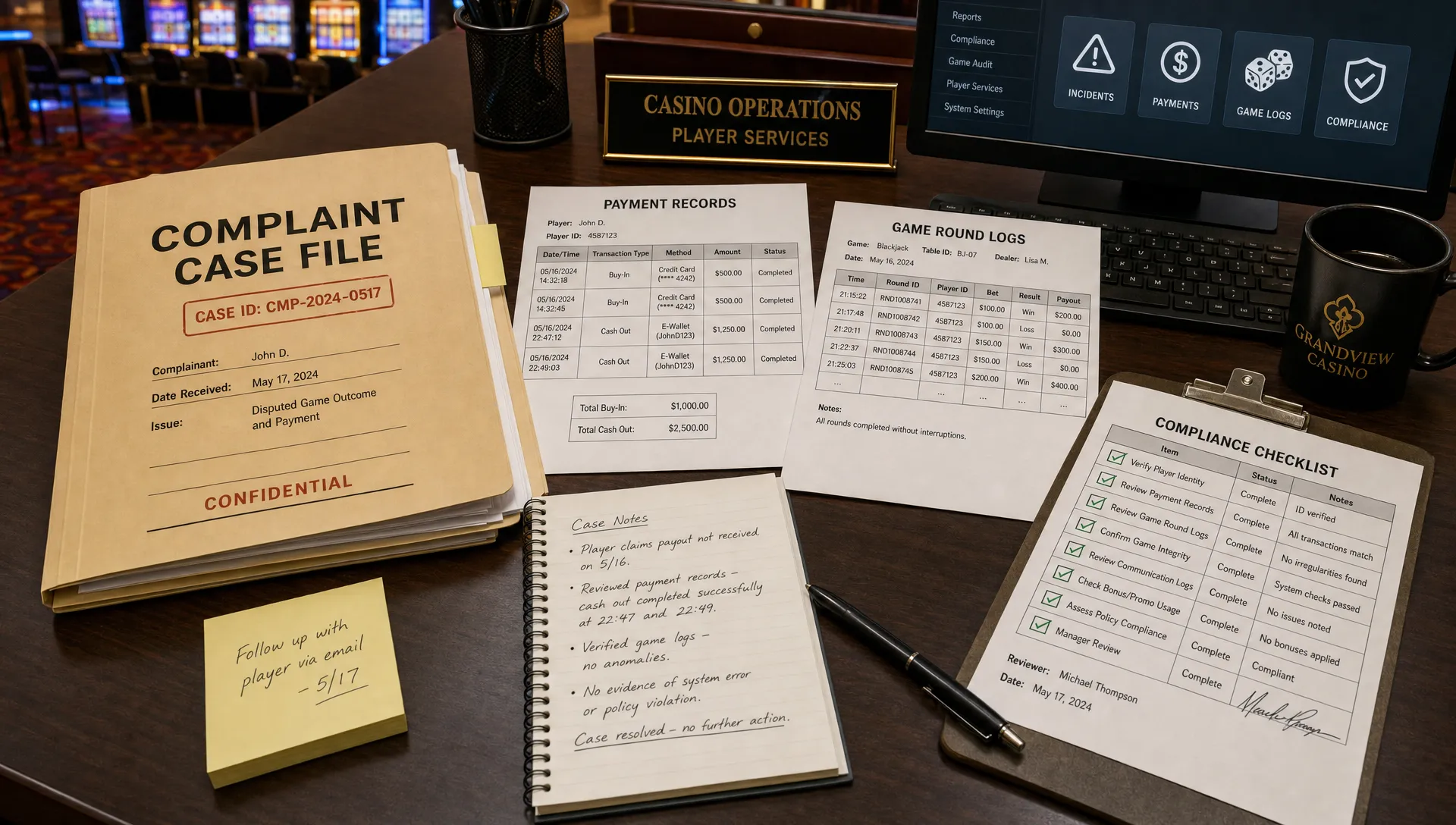
For withdrawal complaints, the investigation should distinguish between a normal processing delay, a payment provider issue, a missing KYC requirement, a risk review and an AML hold. Each has a different communication requirement and different operational owner. Spinlab’s article on casino withdrawal holds goes deeper on when to review and when to release payments automatically.
6. Decide the Remedy Using a Consistent Framework
The resolution should match the evidence and the harm. Overcompensating every complaint trains abuse. Refusing reasonable remedies damages trust and may create bigger costs later.
Common remedies include releasing funds, crediting a missing deposit, reversing an incorrect fee, reinstating a bonus, offering a goodwill bonus, correcting a balance, explaining why the original decision stands or escalating to an external dispute body where required.
A simple remedy framework helps decision makers stay consistent.
| Finding | Suitable response | Notes |
|---|---|---|
| Casino error confirmed | Correct the error and explain the correction | Include transaction references where possible |
| Third-party delay confirmed | Give status, expected next step and follow-up time | Avoid blaming the provider without taking ownership of communication |
| Player breached clear terms | Explain the term, evidence and outcome | Use plain language, not legal boilerplate only |
| Terms were ambiguous | Favor a fair interpretation and revise the terms | Ambiguity often becomes a product problem |
| Fraud or AML concern remains | Limit details but confirm review status and rights | Do not disclose detection rules or tipping off risks |
| Evidence is inconclusive | Use proportional goodwill or senior review | Document why the evidence did not support a firm decision |
For larger cases, require a second review before final response. This is especially important when funds are confiscated, a player is permanently restricted or a complaint involves responsible gambling failures.
7. Communicate the Decision Clearly
A fair decision can still feel unfair if the explanation is vague. “After review, your complaint is rejected” is not enough for most casino player complaints.
A good final response should include the complaint reference, the issue investigated, the evidence reviewed, the decision, any remedy, when the remedy will occur and the next escalation route if the player disagrees. Keep the tone calm and factual.
For example, a bonus dispute response might say: “We reviewed your bonus history, including the opt in timestamp, the bonus terms in force at that time and the bet history for rounds 208114 to 208196. The bonus terms excluded wagers above $5 while wagering was active. Since three wagers exceeded that limit, the winnings from those rounds were removed under section 7.2. We understand this is frustrating, so we have also forwarded the wording of that rule to our promotions team for review.”
The response gives the player a reason, not just a result. It also creates a clean record if the case later becomes a regulator complaint or chargeback.
8. Escalate When the Player Challenges the Outcome
Escalation is not a failure. It is part of a controlled complaints process. If the player disputes the first decision, route the case to a senior reviewer who was not the original decision maker.
The senior review should check whether the evidence was complete, the policy was applied correctly, the communication was clear and the remedy was proportionate. If the answer changes, explain why. If the answer stays the same, confirm the escalation options available in the player’s jurisdiction or under the casino’s license.
Payment related complaints may also become chargebacks. The complaint file then becomes part of the evidence pack used for representment, including transaction records, account activity, KYC events, bonus acceptance and communication history. If your product team handles frequent payment disputes, Spinlab’s guide to chargeback representment for casinos explains what evidence typically matters in the dispute lifecycle.
9. Close the Case and Fix the Root Cause
Closing a complaint should not mean burying it. Every valid complaint is a signal about where the product, payment stack, terms, support scripts or risk controls are unclear.
Tag the root cause before closing the case. Was the complaint caused by a payment gateway delay, a confusing cashier message, a vague bonus term, a provider outage, manual review backlog, poor KYC instructions or a genuine player misunderstanding?
The best operators review complaint trends weekly. A single complaint may be noise. Twenty complaints about the same withdrawal status message are a product issue. Repeated disputes about one bonus term suggest the term needs rewriting or the promotion needs better in-product warnings.
Metrics That Make Complaints Manageable
Casino operators should track complaint quality, not just volume. High ticket volume can mean growth, but rising complaint ratios often point to operational friction.
Useful metrics include complaint rate per active player, complaints by category, average time to first response, average time to resolution, percentage resolved at first decision, escalation rate, regulator or ADR escalation count, upheld complaint percentage and repeat complaint rate by root cause.
Track these metrics alongside payments, KYC, fraud and game provider performance. If withdrawal complaints spike when a specific payment gateway slows down, the support team is not the root problem. If bonus complaints spike after a promotion launch, the issue may be wording, eligibility logic or frontend disclosure.
How Platform Design Improves Complaint Resolution
Complaint handling becomes much harder when the casino stack is fragmented. Support sees one version of the account, payments sees another, compliance stores evidence somewhere else and game providers must be contacted manually for every round dispute.
A modern iGaming platform should make fair resolution easier by giving teams access to structured data, role based workflows and a reliable audit trail. This does not remove human judgment, but it reduces the amount of time teams spend searching for basic facts.
For whitelabel casino operators, this is especially important. A fast launch is valuable only if the backoffice can support the realities of live operations: payment reviews, KYC checks, bonus adjustments, game aggregation issues, affiliate questions and player complaints. When payments, fraud prevention, KYC and AML workflows are connected to the same operational view, complaint teams can move faster without making careless decisions.
Common Mistakes to Avoid
The most common mistake is treating complaints as isolated support conversations. If a player’s deposit is missing, that complaint belongs to payments, reconciliation and support. If a self excluded player says they were able to reopen an account, that complaint belongs to compliance immediately.
Another mistake is hiding behind generic terms. Operators need terms and conditions, but players deserve an explanation that connects the term to the facts of their case. A wall of legal language rarely resolves anger and may create the impression that the casino did not investigate.
Casinos also weaken their position when they edit balances without clear notes. Manual adjustments may be necessary, but every adjustment should show who made it, why it was made, what evidence supported it and how the player was informed.
Finally, do not let complaint data sit unused. If the same issue appears repeatedly, the fair resolution is not only to compensate affected players. It is to fix the broken flow that caused the complaints in the first place.
Frequently Asked Questions
How quickly should an online casino respond to player complaints? Operators should acknowledge complaints as quickly as possible and give a clear expected update time. The exact deadline depends on the license, jurisdiction and complaint type, but silence is what usually makes complaints escalate.
Should every player complaint lead to compensation? No. Compensation should depend on the evidence, the casino’s terms and the harm caused. A fair process may confirm the casino acted correctly, but the player still deserves a clear explanation.
What evidence matters most in casino player complaints? The most useful evidence usually includes wallet ledger entries, payment gateway statuses, KYC events, bonus opt in records, game round IDs, provider logs, support transcripts and account activity history.
How should casinos handle complaints involving AML or fraud reviews? Operators should communicate the status and expected next step without revealing sensitive detection rules or creating tipping off risk. These cases should be handled by trained risk or compliance staff, not only frontline support.
Can complaint workflows reduce chargebacks? Yes. Clear communication, faster payment explanations and documented evidence can reduce frustration driven chargebacks and improve the casino’s position if a dispute is filed.
Build Fair Complaint Resolution Into the Casino Stack
Fair complaint handling depends on people, policy and platform design. Teams need clear ownership, players need timely explanations and operators need records that show what happened from registration through deposit, gameplay, bonus use, KYC and withdrawal.
Spinlab offers a modular, crypto-ready white label casino platform with integrated payments, game aggregation, KYC and AML support, fraud prevention, real-time analytics and a customizable backoffice admin panel. For operators building or scaling an online casino, that connected operational layer can make complaint resolution faster, clearer and easier to audit.